
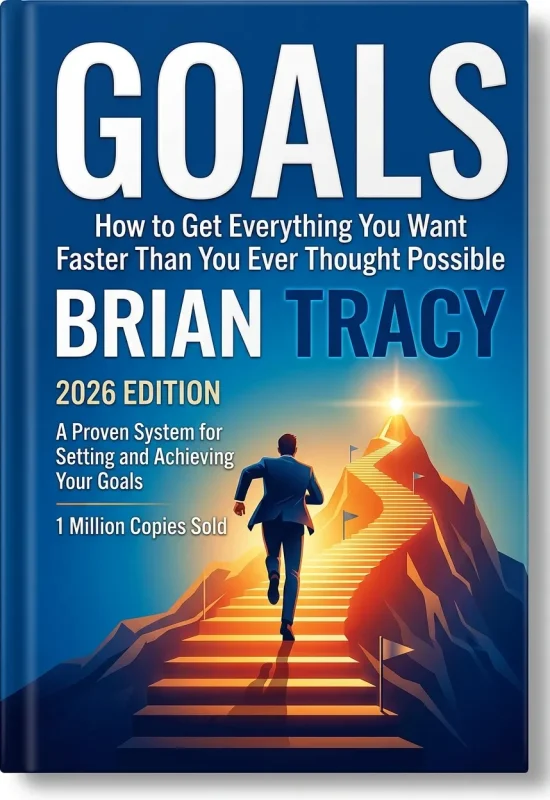
Goals by Brian Tracy Summary: The 12 Steps to Get Everything You Want Faster (2026)
Author: Brian Tracy
Published: 2003
Pages: 304
Genre: Self Help & Personal Development
Reading Time: 18 Minutes
Goals by Brian Tracy summary: explore the 12-step goal-setting process, seven key principles, practical lessons, criticisms, and whether Goals! is still worth reading in 2026.
Table of Contents
ToggleIntroduction
Most people have goals. The harder part is turning those goals into a clear plan and following that plan consistently. In Goals!: How to Get Everything You Want Faster Than You Ever Thought Possible, Brian Tracy presents a structured approach to goal setting built around clarity, planning, action, discipline, and persistence.
First published in 2003, the book’s updated Third Edition was released in December 2024 and includes approximately 20% additional content and a new chapter. The publisher describes the book as a step-by-step system for setting and achieving goals across different areas of life.
This goals Brian Tracy summary breaks down the book’s central ideas, its seven key principles, the 12-step goal-setting process, its strengths and weaknesses, and whether it is still worth reading in 2026.

Who is Brian Tracy?
Brian Tracy is a personal-development author, speaker, and business trainer known for books and programs focused on goal setting, productivity, sales, leadership, and personal achievement. His approach is strongly practical. Rather than treating success as something mysterious, Tracy emphasizes defining what you want, putting it in writing, creating a plan, developing the required skills, and taking consistent action.
Goals! brings many of these ideas together into a structured system that can be applied to career, financial, health, family, and personal objectives.
What is the Goals Book by Brian Tracy About?
At its core, Goals! makes a simple distinction:
A wish is something you would like to happen. A goal is something you have clearly defined and committed to pursuing.
Tracy argues that vague ambitions are difficult to act on because there is no clear destination or measurement. Compare:
“I want to make more money.”
with:
“I want to increase my annual income to a specific amount by a specific date.”
The second statement gives you something to measure, plan for, and work toward. The book therefore focuses heavily on clarity before action.
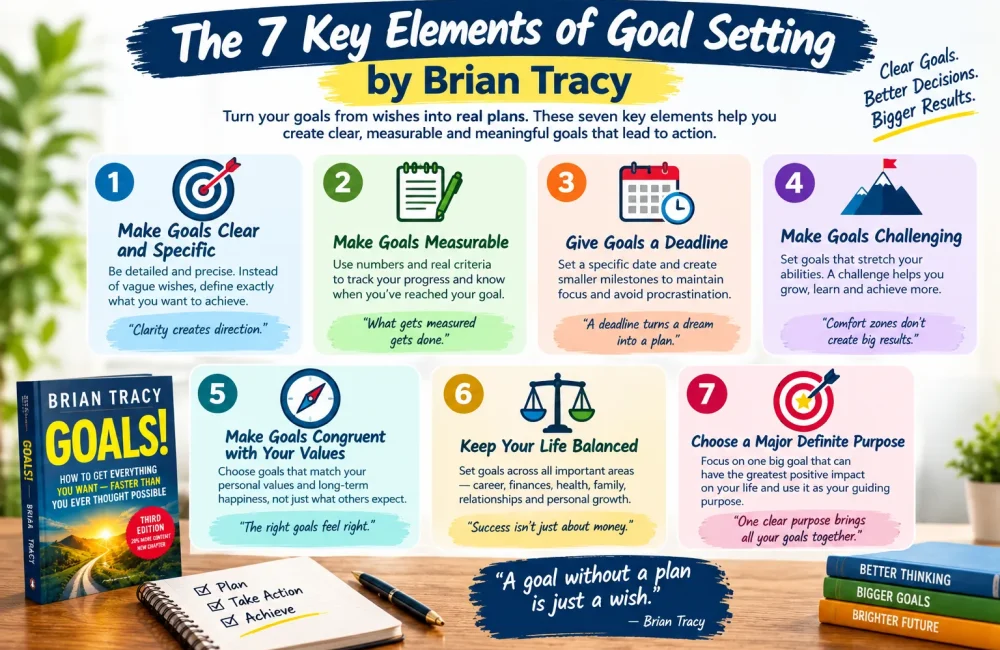
The 7 Key Elements of Goal Setting
One of the important frameworks in Goals! is Tracy’s seven keys to effective goal setting. These principles provide the foundation for the more detailed 12-step process.
1. Make Your Goals Clear and Specific
A useful goal should be detailed enough that you know exactly what you are trying to accomplish. Instead of: “I want to become successful.” define what success actually means.
For example:
- a specific income level
- a particular career position
- a measurable fitness target
- a business milestone
- a specific personal achievement
Clarity gives you a destination.
2. Make Your Goals Measurable
You need a way to determine whether you are progressing. A measurable goal gives you evidence rather than relying on feelings.
For example:
“Read more books” is vague.
“Read 24 books this year” gives you something concrete to track.
3. Give Your Goals a Deadline
A goal without a target date can remain permanently in the future. Tracy emphasizes deadlines and intermediate milestones because they create a framework for action and progress. The deadline doesn’t have to be perfect. It can be adjusted when circumstances change.
4. Make Your Goals Challenging
Tracy encourages goals that stretch your abilities rather than simply repeating what you have already accomplished. A challenging goal can force you to develop new skills, improve your discipline, and think differently. At the same time, a goal should remain believable enough that you are willing to seriously pursue it.
5. Make Your Goals Congruent With Your Values
Your goals should fit your deeper priorities. For example, pursuing extreme career growth while completely ignoring your health or family may create conflicts between your goals. Tracy therefore emphasizes harmony between your objectives and values.
6. Keep Your Life Balanced
Goal setting should not be limited to money or career. Tracy discusses goals across different areas of life, including:
- career and business
- finances
- family
- health
- personal development
- spirituality
- community
The broader idea is that achievement in one area shouldn’t completely destroy the others.
7. Choose a Major Definite Purpose
Tracy encourages readers to identify one major goal that could have the greatest positive impact on their lives. This major definite purpose becomes a central direction around which other goals can be organized.
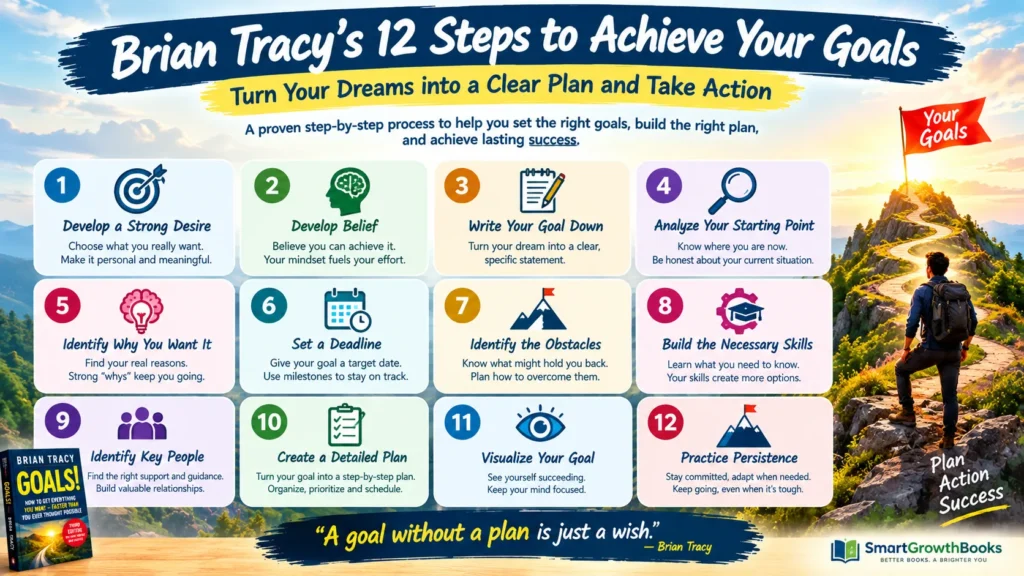
Brian Tracy’s 12 Steps to Achieve Your Goals
The seven keys provide the foundation. The 12-step process turns that foundation into a practical sequence.
1. Develop a Strong Desire
Start by deciding what you genuinely want. The goal should be personal rather than something chosen simply because another person expects it from you.
Ask:
What do I really want?
The stronger the personal reason behind a goal, the easier it becomes to maintain motivation when progress becomes difficult.
2. Develop Belief in Your Goal
You also need to believe that achieving the goal is possible. This doesn’t mean pretending that every goal is easy. It means developing enough confidence to commit to the process. A useful goal should stretch you without becoming so unrealistic that you stop taking it seriously.
3. Write the Goal Down
Writing turns an abstract idea into something concrete. Instead of keeping your goal only in your head, put it on paper in clear language. This also gives you something to review and refine.
4. Analyze Your Starting Point
Before creating a plan, understand where you currently stand. Ask:
- What resources do I already have?
- What skills do I have?
- What am I missing?
- What is my current financial or professional position?
- What habits are helping me?
- What habits are holding me back?
Knowing your starting point makes the goal more realistic.
5. Identify Why You Want the Goal
Ask yourself:
Why is this goal important to me?
List the benefits you expect from achieving it. Your reasons can provide motivation when the excitement of starting a new goal begins to disappear.
6. Set a Deadline
Give the goal a target completion date. For larger goals, create smaller milestones along the way.
For example:
Long-term goal → yearly milestone → monthly milestone → weekly action.
This turns a distant objective into something you can work on today.
7. Identify the Obstacles
Ask:
What is preventing me from achieving this goal right now?
The obstacle might be:
- lack of knowledge
- lack of skills
- poor habits
- insufficient resources
- fear
- procrastination
- lack of planning
- external circumstances
Identifying the obstacle is important because you cannot solve a problem you haven’t clearly defined.
8. Identify the Knowledge and Skills You Need
Determine what you need to learn. If you want a promotion, you may need new professional skills. If you want to start a business, you may need sales, marketing, financial, or operational knowledge. The goal isn’t simply to work harder. It is also to become more capable.
9. Identify the People Who Can Help
Some goals require cooperation, guidance, mentoring, or support from other people. Identify:
- mentors
- colleagues
- experts
- partners
- customers
- family members
- professional networks
Then consider what value you can provide in return.
10. Create a Detailed Plan
Now bring everything together. Your plan should include:
- tasks
- priorities
- deadlines
- required skills
- resources
- people
- obstacles
- milestones
The purpose of planning is not to predict the future perfectly. It is to create a direction that you can improve as you learn.
11. Visualize the Goal
Tracy also emphasizes visualization. The idea is to create a vivid mental picture of the desired outcome and repeatedly bring your attention back to it. This can help keep the goal emotionally meaningful. However, visualization works best when combined with planning and action—not as a substitute for them.
12. Commit to Persistence
Finally, expect obstacles. A goal rarely progresses in a perfectly straight line. You may need to adjust the deadline, improve your skills, change your strategy, or create a different plan. Persistence means continuing to work toward the objective while adapting your approach when necessary.
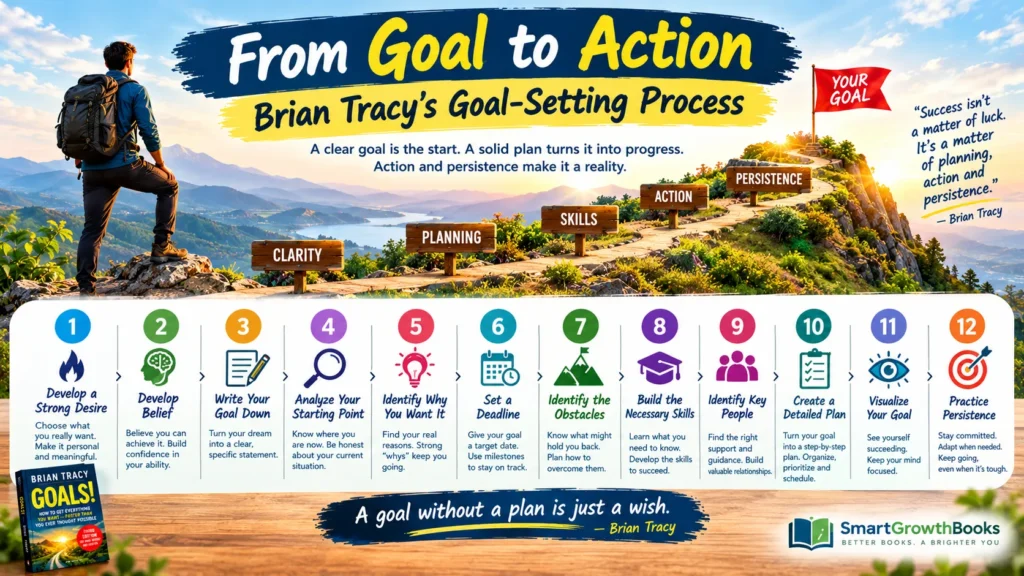
The Bigger Picture: What Is Tracy Really Teaching?
The 12 steps are only one part of Goals!. The broader message is that achievement requires more than simply writing down an ambition.
You need:
Clarity → Desire → Planning → Skills → Action → Persistence
This is what makes the framework useful. You don’t need to agree with every motivational claim in the book to benefit from its central process.
The practical value comes from forcing yourself to answer questions that many people avoid:
What exactly do I want?
Why do I want it?
Where am I starting from?
What is stopping me?
What do I need to learn?
Who can help?
What should I do next?
What Goals by Brian Tracy Does Well
1. It Gives You a Complete Framework
Instead of providing isolated motivational tips, Tracy connects goal definition, planning, skills, obstacles, action, and persistence.
2. It is Highly Practical
Many of the exercises can be applied immediately. You don’t need special software or complicated systems. A notebook and an honest assessment of your goals can be enough to get started.
3. It Covers More Than Career Goals
The framework can be applied to:
- career
- business
- money
- health
- relationships
- personal development
The publisher also describes the Third Edition as covering areas including personal values, financial freedom, relationships, health, career, self-doubt, and procrastination.
4. It Encourages Personal Responsibility
Tracy repeatedly brings the reader back to questions about choices, skills, planning, and action. That can be useful for people who feel stuck but don’t know where to begin.
Where Goals by Brian Tracy Falls Short
No self-help book is perfect, and Goals! has limitations.
1. Some Ideas Feel Repetitive
If you have already read several classic books on goal setting, productivity, or personal development, some concepts will feel familiar. Writing goals down, setting deadlines, visualizing success, developing discipline, and taking action are repeated throughout the genre.
2. Some Motivational Claims Are Stronger Than the Evidence
Tracy sometimes uses motivational language about the subconscious mind and mental programming. Readers should treat those ideas as part of Tracy’s motivational framework rather than automatically accepting every psychological claim as established science.
3. It Can Feel Very Structured
People who prefer flexible or highly experimental approaches may find the system somewhat rigid. The framework works best when treated as a toolkit, not a set of laws that must be followed identically.
4. The Book Is Not a Complete Scientific Theory of Goal Achievement
Modern psychology and behavioral science offer additional perspectives on motivation, habits, environment, implementation intentions, and behavior change.
So Goals! is best viewed as a practical self-development framework rather than a definitive scientific explanation of why people succeed.
Who Should Read Goals! by Brian Tracy?
This book is particularly useful for:
- People without a goal-setting system who want a structured starting point
- Students and young professionals trying to decide what they want next
- Entrepreneurs and business owners who need clearer priorities
- People struggling with procrastination who need a more concrete action plan
- Readers who enjoy practical self-help more than theoretical psychology
- Anyone with many ambitions who needs to decide which goal matters most
Who Should Skip It?
You may not need Goals! if:
- You already have a well-developed goal-setting system.
- You’ve read many books covering similar personal-development principles.
- You prefer heavily research-based psychology.
- You dislike structured, checklist-oriented approaches.
- You’re looking for a short motivational read rather than exercises and practical frameworks.
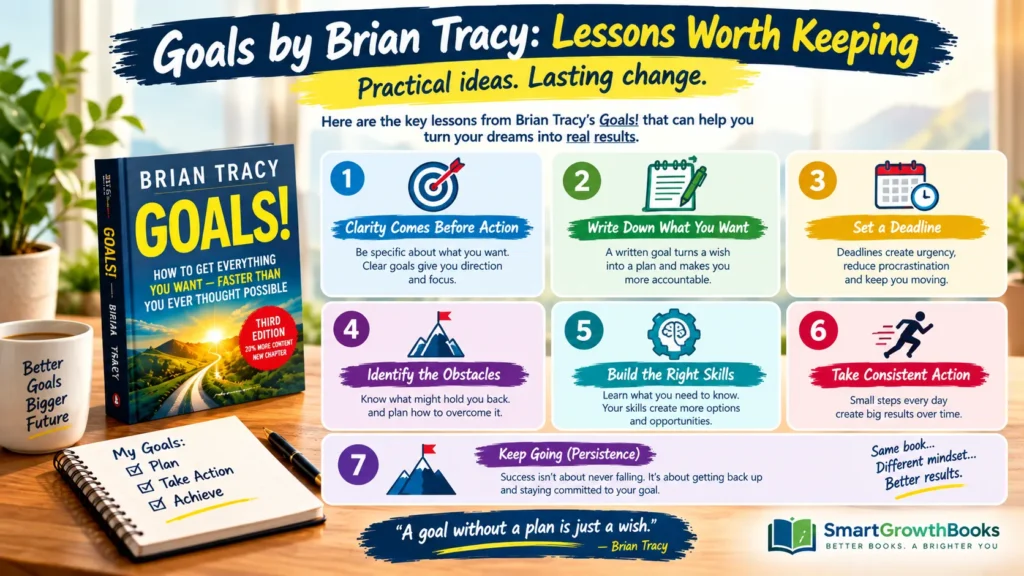
Goals! by Brian Tracy: Key Takeaways
If you remember only a few ideas from the book, remember these:
Be Specific
Vague goals create vague action.
Write Your Goals Down
Make your intentions concrete enough to review and measure.
Know Why You Want Them
A meaningful reason can help sustain motivation when progress becomes difficult.
Understand Your Starting Point
You need to know where you are before you can create a realistic route forward.
Identify the Obstacles
Find the main things standing between your current situation and your desired outcome.
Develop the Necessary Skills
Sometimes the fastest way forward isn’t working harder. It’s learning what you don’t yet know.
Create a Plan
Turn the goal into smaller actions, priorities, and milestones.
Take Consistent Action
A written goal has no value if it never changes what you do.
Review and Adapt
Plans can change when circumstances or information change.
Keep Going
Progress rarely happens perfectly. Persistence includes adapting without abandoning the objective.
Final Verdict: Is Goals! by Brian Tracy Worth Reading?
Yes—with the right expectations.
Goals! is not a revolutionary scientific explanation of human motivation. Much of its advice will sound familiar if you’ve already read widely in the self-help and productivity genres.
But that isn’t necessarily its weakness.
Its greatest strength is that it takes familiar ideas and organizes them into a framework you can actually use.
If you’re starting from scratch and want a practical system for turning ambitions into written goals, plans, and daily action, Goals! remains a useful starting point. The real value isn’t in simply reading the book. It’s in taking one goal, writing it down, understanding why you want it, identifying the obstacles, making a plan, and taking the next meaningful step.
Our Take
At SmartGrowthBooks, we think the most useful way to read Goals! is as a practical goal-setting toolkit, not a guarantee of success. You don’t need to accept every motivational claim in the book. Keep the parts that help:
clarity, written goals, deadlines, planning, skill development, prioritization, action, and persistence.
Then combine them with modern knowledge about habits, behavior, psychology, and realistic planning. That’s where an older self-help classic can still become useful in 2026.
Ready to Turn Your Goals Into Action?
Reading about goal setting is easy. Actually defining what you want and taking the first step is harder.
Start small: choose one important goal, write it down, give it a deadline, identify the biggest obstacle, and decide what you can do about it this week.
If you enjoy practical ideas from books about personal growth, productivity, mindset, career, and success, keep exploring SmartGrowthBooks for thoughtful summaries, reviews, and lessons you can apply to everyday life.
Don’t just read better ideas. Put the useful ones to work.
About the Author
Muhammad Ajmal
Founder & Book Summary Writer at SmartGrowthBooks
Muhammad Ajmal is the founder and book summary writer behind SmartGrowthBooks, where he turns valuable ideas from books into clear, practical, and easy-to-understand insights.
His writing focuses on self-help, productivity, personal growth, psychology, personal finance, and motivation, with an emphasis on helping readers discover the ideas that can make a meaningful difference in everyday life.
At SmartGrowthBooks, the goal isn’t simply to summarize books — it’s to help readers understand the ideas, question them, and put the most useful lessons into practice.
This summary was published in September 2026.
Related Book Summaries
Stay Smarter Every Week
Get practical book summaries, productivity tips, and self-improvement insights delivered to your inbox.