
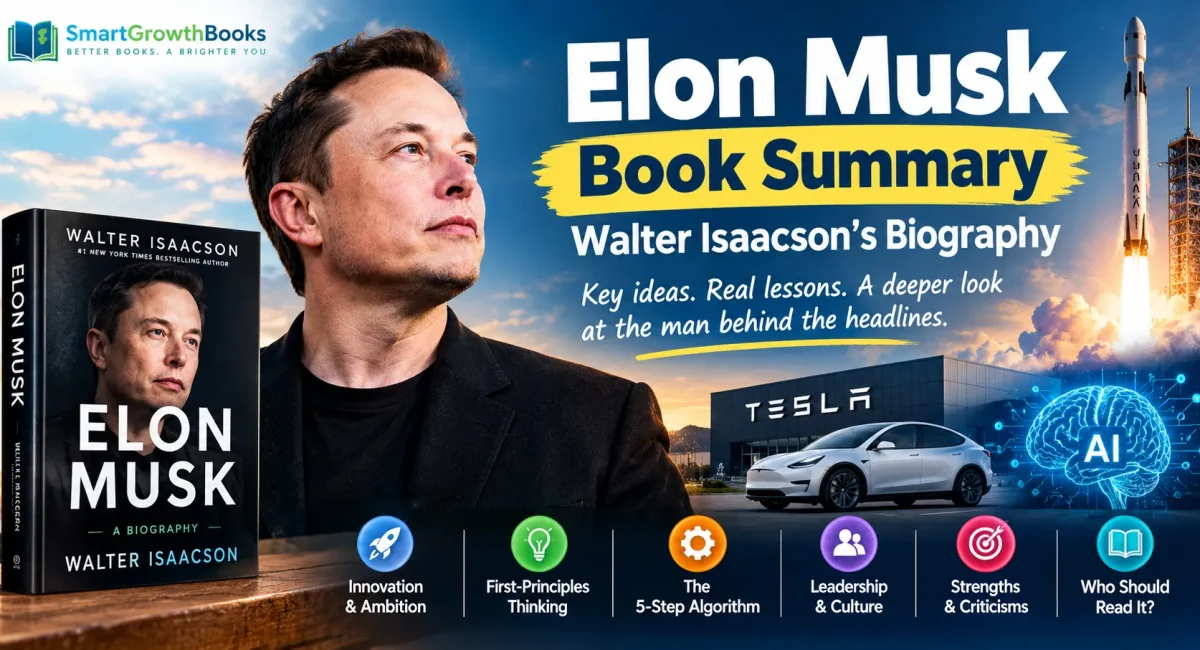
Elon Musk Book Summary: Walter Isaacson’s Biography
Elon Musk book summary of Walter Isaacson’s biography: explore its main ideas, lessons, criticisms, and who should read or skip this 688-page biography.
Book: Elon Musk
Author: Walter Isaacson
Published: 2023
Pages: 688
Genre: Memoir / Business
Reading Time: 12 Minutes
Table of Contents
ToggleIntroduction
If you are looking for an Elon Musk book summary, Walter Isaacson’s Elon Musk offers a detailed account of the entrepreneur’s childhood, companies, relationships, leadership style, and ambitions in technology. Published by Simon & Schuster in September 2023, the 688-page biography was built from about two years of Isaacson shadowing Musk and observing his work at Tesla, SpaceX, and during the Twitter takeover.
The result is less a traditional business success manual and more a character study of a highly ambitious and controversial entrepreneur.
This Elon Musk biography summary explains the book’s main ideas, important episodes, practical lessons, strengths, criticisms, and limitations. It also separates what Isaacson reports from conclusions readers may draw for themselves.
About the Book and Walter Isaacson
Walter Isaacson is known for biographies of figures including Steve Jobs, Albert Einstein, Benjamin Franklin, and Leonardo da Vinci. For Elon Musk, Isaacson spent roughly two years following Musk, observing meetings and company operations, and speaking with family members, friends, colleagues, and others around him. Simon & Schuster describes the book as an intimate account covering Tesla, SpaceX, artificial intelligence, and Musk’s takeover of Twitter.
That access is one of the biography’s defining strengths. Instead of simply describing major events after they happened, Isaacson was able to observe many decisions and conflicts while they were unfolding.
At the same time, close access creates a potential limitation: the closer a biographer gets to a powerful subject, the more important it becomes to compare the subject’s version of events with independent reporting. Reviews in The Washington Post and Los Angeles Times raised concerns about Isaacson’s reliance on Musk’s perspective and the limits of the biography’s critical lens.
Elon Musk Biography Summary: The Big Picture
The central tension in Isaacson’s biography is that Musk’s strengths and weaknesses often appear together.
His willingness to take enormous risks can help him pursue technically difficult projects. The same intensity, however, can contribute to conflict, impulsive decisions, and difficult relationships.
Isaacson presents Musk as someone driven by large missions: making humanity multiplanetary through SpaceX, accelerating electric vehicles through Tesla, and pursuing ambitious ideas around artificial intelligence and other technologies. The biography also documents harsh management practices, personal turmoil, and controversial decisions.
Rather than giving readers a simple hero or villain, the book presents a complicated individual whose achievements and behavior have to be considered together.
Elon Musk Book Summary: Main Ideas Explained
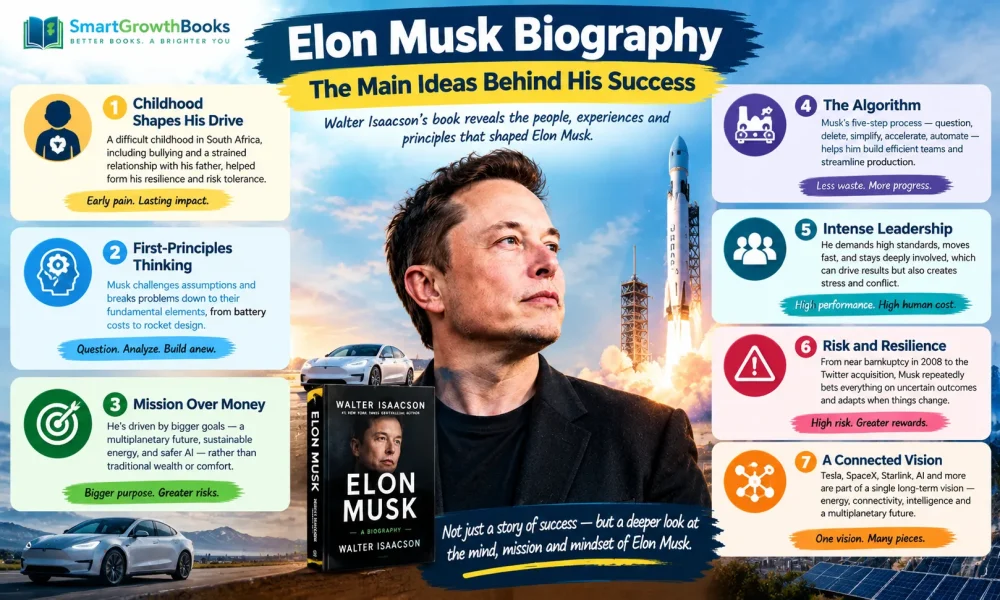
1. Childhood and Early Experiences Shaped His Personality
Isaacson spends considerable time on Musk’s childhood in Pretoria, South Africa. The book describes severe bullying at school and a difficult relationship with his father, Errol Musk. These experiences are presented as important background for understanding Musk’s later relationship with pressure, confrontation, and risk. The Washington Post similarly described Isaacson’s biography as a character study that connects Musk’s childhood experiences with his later behavior.
Musk also found an escape in books, science fiction, computing, and games. His interest in technology and space developed early, eventually becoming connected to his ambition for humanity to become a multiplanetary species. While Musk’s story highlights extreme ambition and execution, Atomic Habits takes a very different approach by focusing on small behaviors and systems that compound over time.
The useful takeaway isn’t that a difficult childhood automatically creates extraordinary achievement. Rather, Isaacson explores how Musk’s experiences became part of the story he tells about himself and the way he approaches difficult problems.
2. Zip2 and PayPal Were Only the Beginning
Before Tesla and SpaceX, Musk helped build Zip2 and later co-founded X.com, an online financial company that became part of PayPal.
After eBay acquired PayPal, Musk had substantial capital available for new ventures. Instead of simply stepping away from business, he invested heavily in SpaceX and Tesla.
Both companies would face serious technical and financial difficulties.
This part of the biography illustrates an important pattern in Musk’s career: after achieving one level of success, he repeatedly moved toward problems that were considerably more difficult and uncertain.
3. Mission Comes Before Comfort
One of the clearest themes in the book is Musk’s attachment to large missions.
SpaceX is connected to his belief that humanity should become multiplanetary. Tesla is connected to accelerating the transition toward electric vehicles and sustainable energy.
These missions help explain why Musk was willing to accept significant financial and operational risks.
The biography’s account of 2008 is particularly important. SpaceX had suffered three Falcon 1 launch failures while Tesla was struggling for cash during the global financial crisis. The fourth Falcon 1 launch succeeded, and Tesla secured financing that helped it survive.
If you are more interested in turning ambitious ideas into specific goals and action plans, our Goals by Brian Tracy summary offers a more structured approach to goal setting.
The lesson isn’t simply “never give up.” The episode also shows the importance of technical learning, timing, capital, and circumstances beyond any founder’s control.
4. First-Principles Thinking
Another major idea associated with Musk in the biography is first-principles reasoning.
Instead of accepting an established price, process, or assumption, the approach is to break a problem down into its fundamental components and then rebuild the solution.
This way of thinking appears repeatedly in Tesla and SpaceX, particularly in discussions about manufacturing, rockets, batteries, and costs.
For ordinary readers, the broader lesson is useful:
When a problem seems impossible, ask which limitations are genuine constraints and which are simply assumptions inherited from the way things have always been done.
That principle can apply to business, studying, productivity, engineering, and even everyday problem-solving.
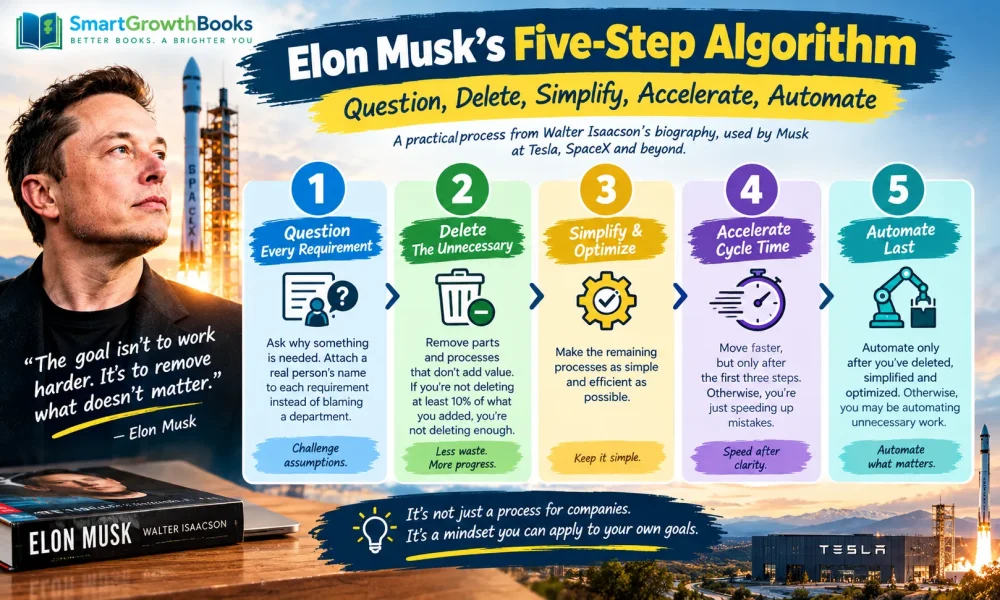
5. The Algorithm: Question, Delete, Simplify, Accelerate, Automate
One of the most practical ideas discussed in Elon Musk is what Musk calls “the algorithm.”
The sequence is:
- Question every requirement.
- Delete unnecessary parts or processes.
- Simplify and optimize what remains.
- Accelerate the cycle time.
- Automate only after the earlier steps.
The order is important.
If you automate a process that should have been eliminated, you have simply made unnecessary work happen faster.
This is one of the easiest ideas from the biography to apply outside Musk’s companies.
For example, a freelancer could question unnecessary meetings, delete repetitive tasks, simplify a workflow, speed up delivery, and only then automate parts of the remaining process.
6. Intense Leadership Has Benefits and Costs
Isaacson describes a management style built around urgency, technical detail, aggressive deadlines, and high expectations.
Musk frequently becomes deeply involved in engineering problems rather than leaving everything to layers of management. The biography also documents difficult interactions with employees and colleagues. The Los Angeles Times specifically noted that the book details Musk’s treatment of workers and colleagues alongside his business achievements.
This is an important distinction for readers.
The useful lesson isn’t “be as harsh as Musk.”
A more reasonable lesson is that extremely high standards can sometimes accelerate execution, but leadership methods also affect workplace culture, stress, retention, and people’s willingness to speak honestly.
7. 2008 Was a Defining Test
The 2008 section is one of the most dramatic parts of the biography.
SpaceX had experienced repeated launch failures, while Tesla was struggling financially during a major economic crisis. SpaceX’s fourth Falcon 1 launch finally succeeded on September 28, 2008. Tesla also managed to secure financing later that year.
Isaacson uses this period to illustrate Musk’s willingness to keep betting on projects when failure seemed very possible.
But there is another lesson here: persistence works best when it is combined with adaptation.
Musk’s companies did not survive simply because he refused to quit. They also changed technology, manufacturing methods, financing strategies, and execution approaches.
Musk’s emphasis on intense focus also raises an interesting question about how much focused work can actually be accomplished in a distracted environment, a topic we explore in our guide to Deep Work for Freelancers.
8. Twitter Reveals a Different Side of Musk
The Twitter acquisition provides one of the clearest examples of Musk’s decision-making outside traditional engineering.
Isaacson was present during the period surrounding Musk’s acquisition of Twitter in 2022. The biography covers the takeover, leadership changes, layoffs, and Musk’s attempt to reshape the platform around his views about free speech and technology.
This section also demonstrates why readers should be careful with a biography published while events are still developing.
The Twitter story continued changing after the book was published, and some details in the biography were disputed or corrected.
The Starlink Correction: An Important Limitation
One of the most important factual problems associated with Elon Musk concerns Starlink and Ukraine.
The original account suggested that Musk ordered Starlink coverage around Crimea disabled during a planned Ukrainian attack on Russian naval forces.
Isaacson later acknowledged that this sequence was incorrect. He clarified that coverage in the area had already been restricted and that Ukrainian officials asked Musk to enable it for the attack, which he refused to do. The Washington Post reported that Isaacson and Simon & Schuster said subsequent editions would be corrected.
This is important for anyone using the biography as a source.
The book contains valuable firsthand reporting, but readers should not assume that every dramatic account is automatically the final verified version of an event.
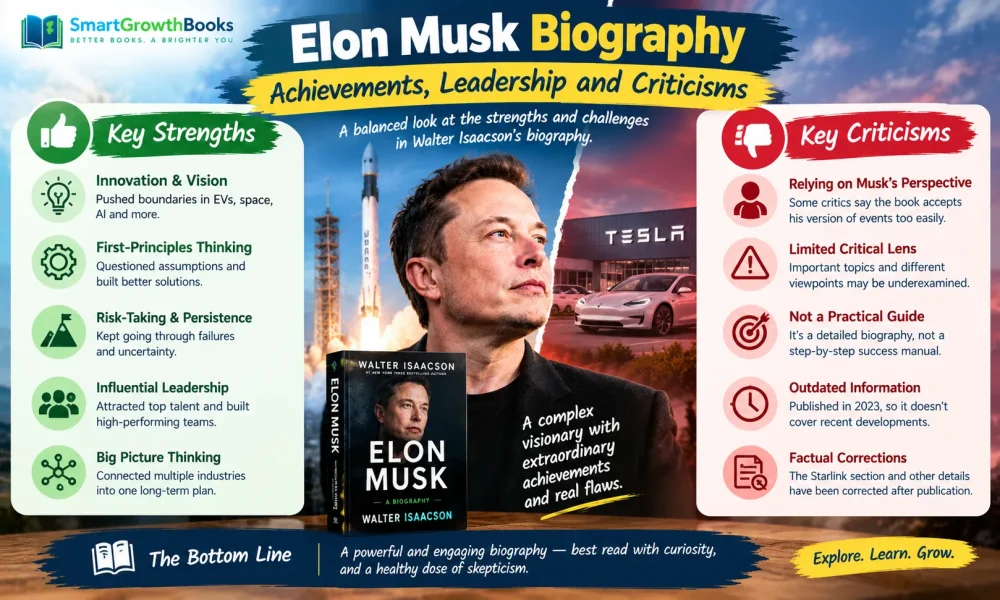
What Isaacson’s Biography Does Well
The biography’s biggest strength is its access.
Readers get detailed scenes involving Tesla, SpaceX, Twitter, Musk’s family, and the people working around him. The chronological structure also makes a complicated career easier to follow.
Another strength is that Isaacson does not completely avoid Musk’s difficult behavior. The book includes both impressive technical achievements and troubling personal and managerial behavior.
The book is also engaging despite its length. The Washington Post noted that the biography moves quickly through relatively short chapters.
Where the Biography Falls Short
The biggest limitation is perspective.
Isaacson had unusually close access to Musk, but close access can also make a biographer dependent on the subject’s explanations and framing.
The Washington Post questioned whether Isaacson’s reliance on Musk and people around him sometimes limited the book’s critical perspective. The Los Angeles Times went further, arguing that some topics and perspectives were underexamined.
The book is also not a current investment analysis of Tesla, SpaceX, X, or Musk’s other businesses.
And because the biography was published in 2023, it cannot provide a complete account of everything that has happened since then.
Who Should Read Elon Musk by Walter Isaacson?
This biography is a good fit if you:
- enjoy long-form biographies and business stories;
- are interested in Tesla, SpaceX, technology, or entrepreneurship;
- want to understand Musk’s career chronologically;
- enjoy Isaacson’s biographies of Steve Jobs and other innovators;
- want to examine the relationship between ambition, risk, leadership, and innovation.
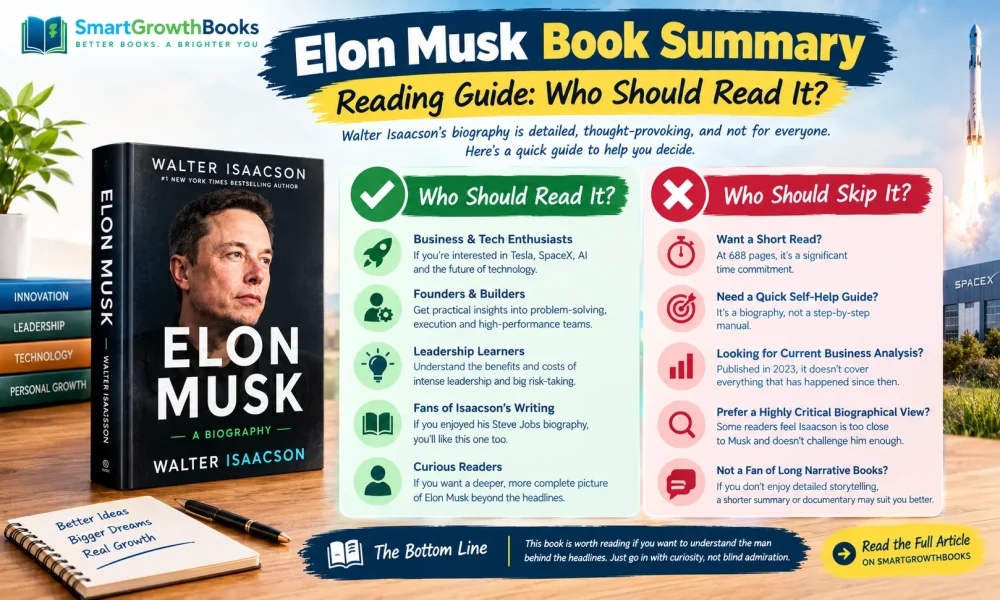
Who Should Skip It?
You may want to skip or postpone it if:
- you want a short motivational book;
- you want a practical step-by-step entrepreneurship guide;
- you want current investment analysis;
- you prefer a highly skeptical investigative biography;
- you are mainly interested in Musk’s current activities rather than his life story.
At 688 pages, it is also a substantial commitment.
Elon Musk Book Summary: 7 Lessons Worth Keeping
1. Question Assumptions
Don’t automatically accept a process simply because everyone else uses it.
2. Think From First Principles
Break difficult problems into their basic constraints before accepting conventional answers.
3. Delete Before You Optimize
Making an unnecessary process more efficient doesn’t make it necessary.
4. Persistence Requires Adaptation
Continuing after failure is useful only when you learn and adjust.
5. Big Missions Can Create Focus
A clear long-term purpose can help people make difficult decisions.
6. High Standards Have Trade-Offs
Ambition and intensity can produce impressive results, but they can also create significant costs for people and organizations.
7. Verify Extraordinary Claims
Even a detailed biography can contain errors, corrections, or incomplete perspectives.
Final Verdict: Is Walter Isaacson’s Elon Musk Worth Reading in 2026?
Walter Isaacson’s Elon Musk is valuable as a detailed narrative about one of the most consequential technology entrepreneurs of the modern era.
Its greatest value is not that it gives readers a formula for becoming successful. Instead, it provides a close case study of ambition, risk, engineering, leadership, personality, and the costs that can accompany extreme intensity.
For SmartGrowthBooks readers, the best way to approach the book is as a case study rather than a manual.
Take the ideas that transfer well—questioning assumptions, solving from fundamentals, removing unnecessary work, learning from failure, and maintaining a clear mission.
At the same time, examine Musk’s management style and personal choices critically rather than assuming that extraordinary achievements justify every method.
If you want the full story, the original biography offers far more detail than any summary can provide. If you mainly want the core ideas and an honest assessment of the book’s strengths and limitations, this Elon Musk book summary gives you a practical starting point.
Our Take
Elon Musk is most useful when read with both curiosity and skepticism.
Isaacson’s access gives the biography unusual depth, but the Starlink correction and the critical reviews show why readers should not treat any single biography as the complete picture.
The most transferable lesson isn’t “be more like Elon Musk.”
It is to ask better questions, challenge unnecessary assumptions, and understand the trade-offs behind the methods you choose.
Ready to Explore More Books on Innovation and Personal Growth?
You don’t have to copy Elon Musk’s personality or lifestyle to learn from his story.
Take one practical idea from the biography—question an assumption, remove an unnecessary step, or rethink a problem from first principles—and apply it to something you’re working on this week.
If you enjoy practical ideas from books about innovation, productivity, entrepreneurship, mindset, technology, and personal growth, keep exploring SmartGrowthBooks for thoughtful summaries, reviews, and lessons you can actually apply.
Don’t just read better ideas. Put the useful ones to work.
About the Author
Muhammad Ajmal
Founder & Book Summary Writer at SmartGrowthBooks
Muhammad Ajmal researches and writes practical book summaries focused on self-help, productivity, psychology, personal finance, motivation, and personal growth.
This Summary is published on August 2026.
Related Book Summaries
Stay Smarter Every Week
Get practical book summaries, productivity tips, and self-improvement insights delivered to your inbox.