
Steve Jobs Book Summary: Walter Isaacson’s Biography
Steve Jobs book summary of Walter Isaacson’s biography: explore his early life, Apple, key ideas, leadership lessons, criticisms, and lasting impact.
Book: Steve Jobs
Author: Walter Isaacson
Published: 2011
Pages: 656
Genre: Biography
Reading Time: 12 Minutes
Table of Contents
ToggleIntroduction
Walter Isaacson’s Steve Jobs is a detailed biography of Apple’s co-founder, covering his childhood, the creation of Apple, his departure from the company, his years at NeXT and Pixar, his return to Apple, and the final years of his life.
Published by Simon & Schuster in October 2011, the book was based on more than forty interviews with Jobs over two years and interviews with more than 100 people who knew or worked with him.
The result is not simply a success story. It is a portrait of a highly creative, demanding, complicated person whose approach to technology, design and business had a major influence on Apple.
This Steve Jobs book summary focuses on the main ideas behind Jobs’s work: product focus, design, simplicity, end-to-end control, the connection between technology and the humanities, and the complicated relationship between high standards and difficult behavior.
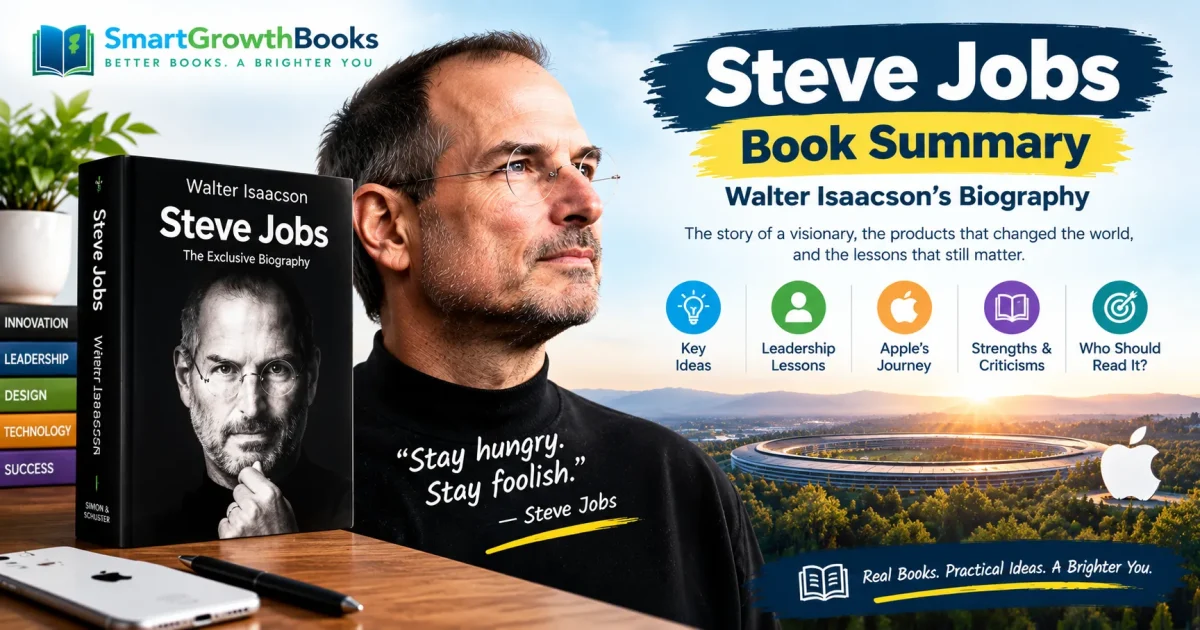
About the Book and Walter Isaacson
Walter Isaacson is a biographer and journalist whose previous subjects included Benjamin Franklin and Albert Einstein. For Steve Jobs, Isaacson interviewed Jobs repeatedly and also spoke with family members, friends, colleagues, competitors and other people connected to him.
The book follows Jobs through the major stages of his life and career. It covers his childhood and education, the founding of Apple with Steve Wozniak, his departure from Apple in 1985, the development of NeXT and Pixar, and his return to Apple in the late 1990s.
It then follows the product decisions that led to the iMac, iPod, iPhone and iPad, alongside the personal and professional difficulties of his final years.
One reason the biography remains useful is its breadth. Isaacson does not present Jobs only as a technology founder. The biography examines how design, music, typography, business, storytelling and technology became interconnected in Jobs’s approach to products. The publisher describes the book as being based on more than forty interviews with Jobs and more than 100 other people connected to him.
Steve Jobs Biography Summary: Early Life and Apple
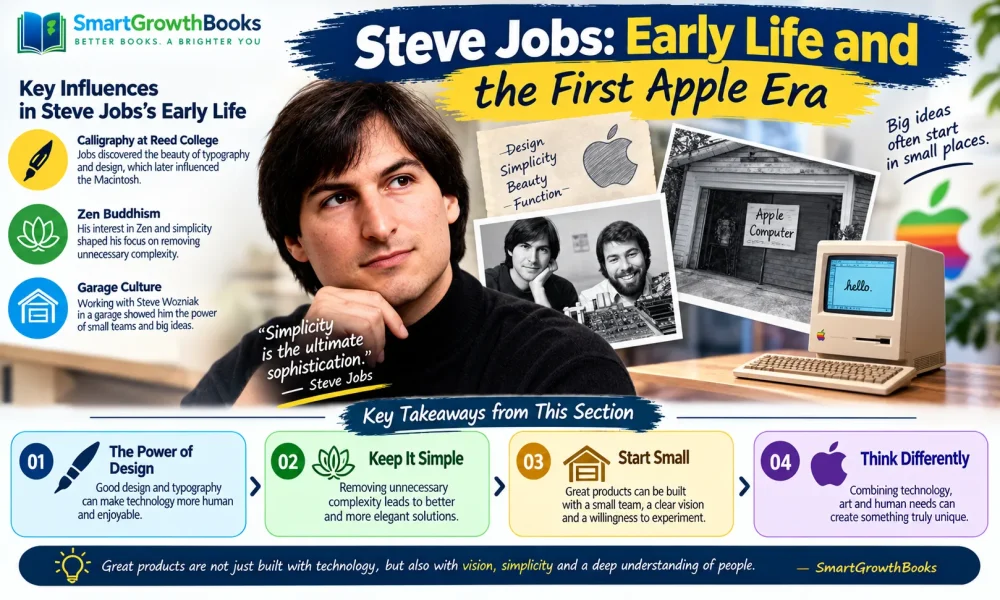
Jobs was born in 1955 and adopted by Paul and Clara Jobs, who raised him in the Silicon Valley area. Isaacson’s account connects several early experiences with ideas that later became important to Jobs’s work.
One was his interest in design and calligraphy. After leaving Reed College, Jobs continued to attend a calligraphy class, an experience he later connected to the typography and fonts used in the Macintosh.
His interest in Zen Buddhism and simplicity also influenced his approach to products and presentation.
In 1976, Jobs and Steve Wozniak co-founded Apple. Wozniak supplied much of the engineering expertise behind the early computers, while Jobs concentrated heavily on product direction, presentation, packaging and how the technology would reach ordinary users.
The Macintosh became an important expression of Jobs’s belief that computers should be approachable and visually appealing.
But his leadership style was already controversial. He could push people toward ambitious goals, yet he could also be impatient, demanding and difficult to work with. Those tensions contributed to the internal conflict that eventually led to Jobs leaving Apple in 1985.
From Apple to NeXT and Pixar
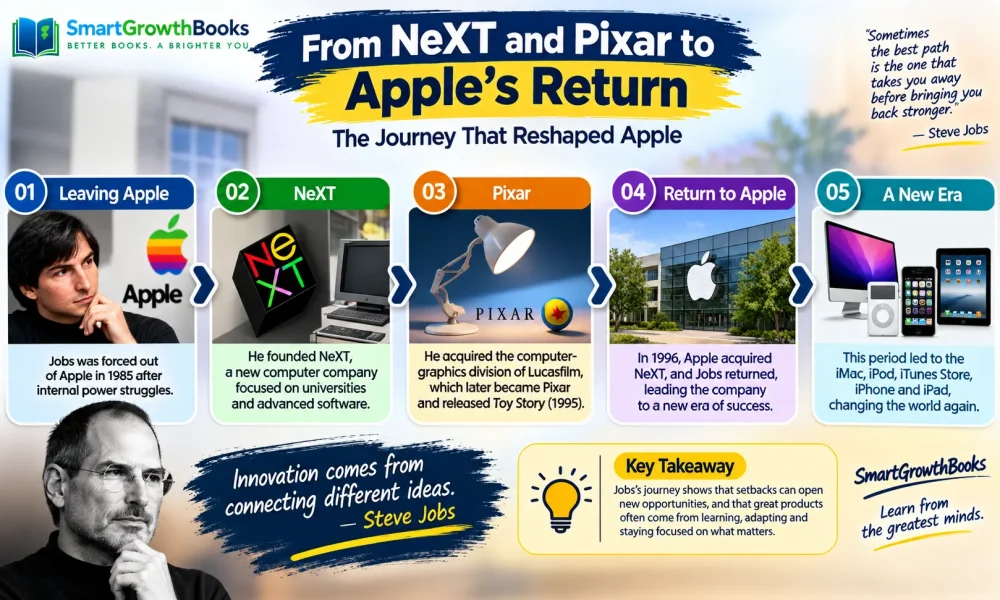
Leaving Apple did not end Jobs’s career. Instead, the next stage gave him two different experiences that later influenced his return.
At NeXT, Jobs pursued a sophisticated computer platform aimed primarily at higher education and professional users. The hardware business did not become a major commercial success, but its software technology later became important when Apple acquired NeXT.
Jobs also became involved with Pixar after acquiring the computer graphics division of Lucasfilm. Pixar eventually released Toy Story in 1995 and became a major force in computer animation.
The NeXT and Pixar years are important because they complicate the idea that Jobs succeeded simply because he was always right.
Some projects struggled commercially. Others succeeded after years of development. The period also exposed Jobs to people and management approaches that differed from his early Apple experience.
When Apple acquired NeXT in 1996, Jobs returned to the company and soon became its central leader again.
Steve Jobs and Apple’s Reinvention
After returning to Apple, Jobs dramatically reduced the company’s product complexity. Rather than trying to serve every possible market, he concentrated attention on a smaller number of products.
This became one of the clearest themes in the biography:
Focus is partly the ability to say no.
Steve Jobs’s emphasis on eliminating distractions also connects naturally with the ideas in our Deep Work book summary, which explores how focused attention can produce better work.
Apple’s later product story followed that philosophy. The iMac emphasized the computer as a complete consumer product. The iPod and iTunes connected hardware, software and digital media. The iPhone combined several functions in one device, while the iPad created another major product category.
Jobs’s partnership with designer Jony Ive was also central. Their work reflected the idea that design was not simply decoration added after engineering was finished. Hardware, software, materials, interfaces, packaging and the overall user experience were treated as parts of one product.
The Main Ideas in This Steve Jobs Book Summary
1. Focus Requires Saying No
One of the clearest lessons from Jobs’s return to Apple is that strategy is not only about deciding what to build. It is also about deciding what not to build. Reducing a complicated product portfolio allowed Apple to concentrate resources on a smaller number of products.
For entrepreneurs and teams, the broader lesson is useful: too many priorities can weaken execution, even when each individual idea sounds worthwhile.
2. Design Is Part of the Product
Jobs treated design as part of how a product worked, not merely how it looked. Typography, packaging, physical materials, interfaces and small details could all affect how people experienced technology.
This helps explain why Apple’s product development often involved designers and engineers working closely together rather than operating as completely separate groups.
3. Technology and the Humanities Can Work Together
Jobs repeatedly connected technology with areas such as typography, music, art and design. His interest in calligraphy became part of the Macintosh story, while his broader philosophy was that technology becomes more meaningful when it is shaped around human experience.
For entrepreneurs and creators, the lesson is that innovation does not always come from technical improvement alone. The way a product feels and communicates can matter as well.
4. End-to-End Control Can Create a Consistent Experience
Apple’s approach to hardware and software gave Jobs greater control over the complete user experience. That approach also involved trade-offs. Closed systems can provide consistency, but they can reduce flexibility compared with more open approaches.
The useful lesson is not that every company should copy Apple. It is that a clear product philosophy sometimes requires deciding which parts of the experience you want to control directly.
5. High Standards Have Benefits and Costs
Jobs was known for demanding standards. Isaacson’s biography also documents the interpersonal costs associated with his behavior.
That distinction is important. High standards can encourage teams to improve their work, but harsh communication does not automatically make high standards more effective.
A practical leadership lesson is to separate the pursuit of quality from behavior that damages trust.
6. Setbacks Can Become Part of a Larger Career
Jobs’s departure from Apple could have ended his influence in the company he helped create. Instead, the years at NeXT and Pixar became part of the experience that preceded his return.
The broader lesson is not that every failure eventually becomes a success. It is that setbacks can provide new skills, relationships and perspectives when people continue learning from them. Steve Jobs’s 2005 Stanford commencement speech is also relevant.
Jobs’s emphasis on deciding what matters and eliminating lower priorities can also be compared with Brian Tracy’s approach to defining goals and turning them into an organized plan in our Goals by Brian Tracy summary.
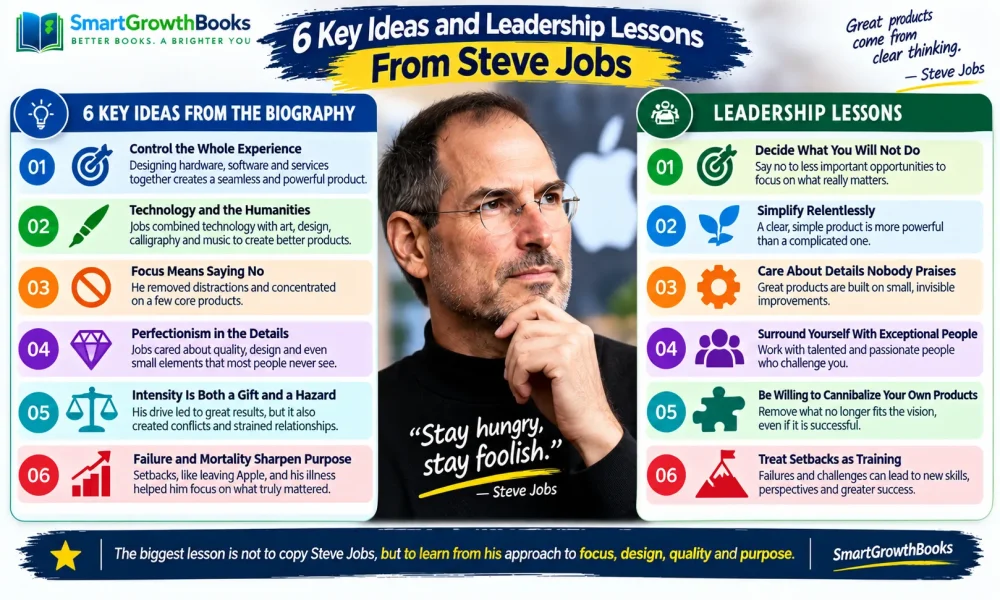
Leadership Lessons From Steve Jobs
Many readers search for leadership lessons from Steve Jobs, but the biography is more useful when treated as a case study rather than a leadership manual.
Protect the most important priorities. Jobs’s decision to narrow Apple’s product focus shows how saying no can protect time, money and attention.
Hire people who care about the quality of the work. Jobs placed considerable emphasis on talent and product standards. At the same time, his treatment of employees shows why strong teams also need healthy communication and respect.
Make the product understandable. Jobs understood that technology can be difficult to explain. Apple’s presentations and products often tried to reduce that complexity for users.
Connect different disciplines. The Apple story repeatedly brings together engineering, design, business, music, typography and storytelling.
Don’t confuse intensity with good leadership. Jobs achieved extraordinary results, but the biography also records behavior that people found hurtful or exhausting. His achievements can be studied without treating every part of his personality as a model to copy.
If you want to explore the other side of personal improvement — building consistent behavior rather than relying on intensity — our Atomic Habits book summary offers a useful contrast.
What the Biography Does Well
The biggest strength of Isaacson’s biography is access. The publisher confirms that Isaacson conducted more than forty interviews with Jobs over two years and interviewed more than 100 family members, friends, competitors and colleagues.
The book also avoids reducing Jobs to a simple hero narrative. It includes creativity and achievements alongside conflicts, failures, difficult relationships and controversial behavior.
Where the Biography Falls Short
The biography should still be read as one interpretation of Jobs’s life, not the final word on every event or personality judgment.
Later discussions about Jobs’s legacy included criticism of Isaacson’s portrayal. Reporting around Becoming Steve Jobs, for example, documented objections from Tim Cook and Jony Ive concerning aspects of the earlier biography’s portrayal of Jobs.
That does not make Isaacson’s biography useless. It simply means readers should distinguish between documented events, Isaacson’s interpretation and later interpretations of Jobs.
There is also a practical limitation: the book is a long narrative biography, not a step-by-step productivity or leadership course. Readers looking only for quick techniques may find a full biography slower than a conventional self-help book.
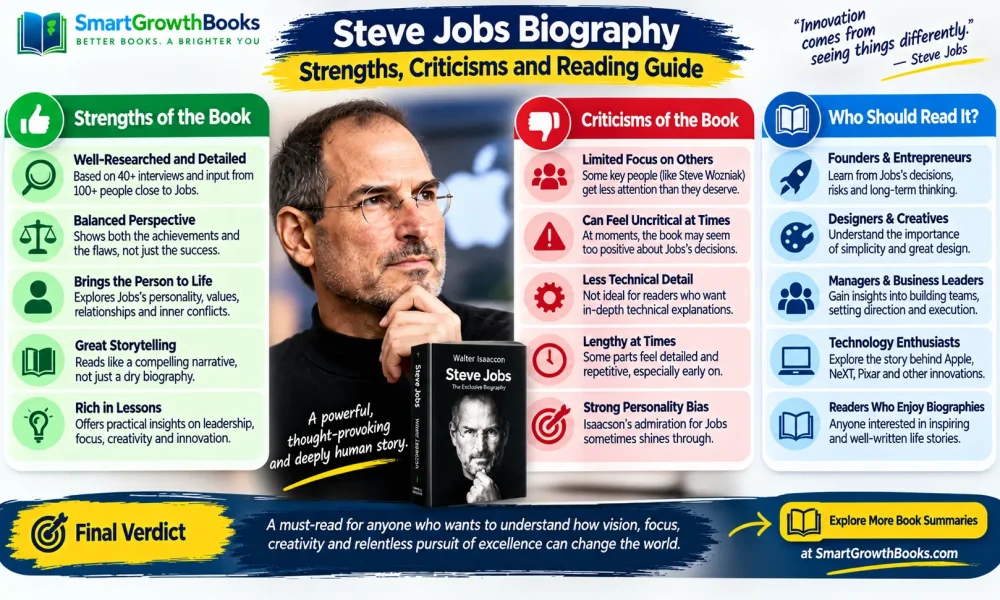
Who Should Read Steve Jobs by Walter Isaacson?
This biography is particularly relevant to:
- Entrepreneurs and founders interested in product vision and decision-making.
- Designers and product managers interested in the relationship between design and technology.
- Business and leadership readers who want a complicated real-world case study.
- Apple and technology enthusiasts who want the story behind major products.
- Biography readers interested in Walter Isaacson’s approach to influential figures.
If you are interested in another Walter Isaacson biography of a modern technology entrepreneur, you can also explore our Elon Musk book summary and compare the two portraits of innovation, leadership, and ambition.
Who Should Skip or Approach It Differently?
You may want to start with a shorter summary if you:
- Want a quick list of productivity or leadership techniques.
- Have limited time for a long biography.
- Prefer a technical engineering history of Apple’s products.
- Want a consistently positive portrayal of Steve Jobs.
- Are mainly interested in practical self-improvement rather than biography.
A summary can help you decide whether the full book matches your interests before committing to the complete reading experience.
Key Takeaways From Steve Jobs
- Focus is a competitive advantage. Saying no can be as important as choosing what to pursue.
- Design affects usefulness. Good design considers the entire experience, not only appearance.
- Different disciplines can strengthen each other. Technology can become more powerful when combined with design and the humanities.
- High standards need healthy leadership. Quality and respect do not have to be opposites.
- Control has trade-offs. End-to-end integration can create consistency while reducing openness.
- Failure can become useful experience. Jobs’s NeXT and Pixar years became important parts of his later career.
- Study results without copying every behavior. Jobs’s achievements and shortcomings can both be examined.
Final Thoughts
Walter Isaacson’s Steve Jobs is valuable because it presents a complicated founder rather than a simple success formula. The biography connects Jobs’s interest in design, technology, focus and storytelling with the products and decisions that shaped Apple’s history.
The most useful way to read it is not to ask:
“How can I become Steve Jobs?”
A better question is:
“Which ideas about focus, design, standards and product thinking can I apply without copying the parts of his behavior that caused harm?”
That approach turns the biography into something more useful than admiration. It becomes a case study in how vision, taste, persistence, leadership and personal flaws can exist in the same person.
If you enjoy comparing different approaches to success, productivity, and personal growth, visit our Book Comparisons section for more side-by-side analysis.
About the Author
Muhammad Ajmal
Founder & Book Summary Writer at SmartGrowthBooks
Muhammad Ajmal researches and writes practical book summaries focused on self-help, productivity, psychology, personal finance, motivation, and personal growth.
This Summary is published on October 2026.
Related Book Summaries
Stay Smarter Every Week
Get practical book summaries, productivity tips, and self-improvement insights delivered to your inbox.