
Table of Contents
ToggleIntroduction
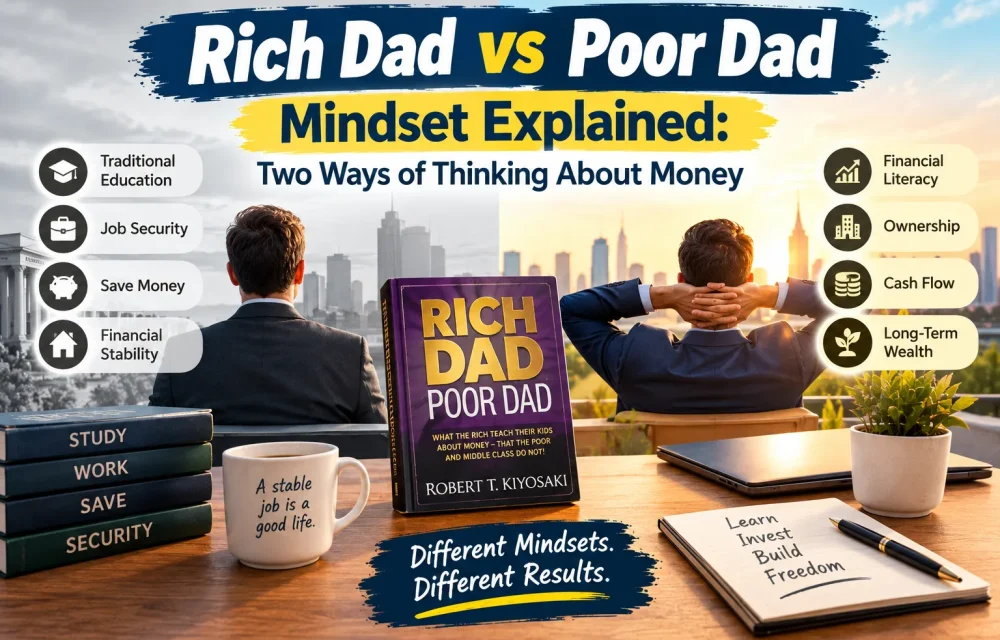
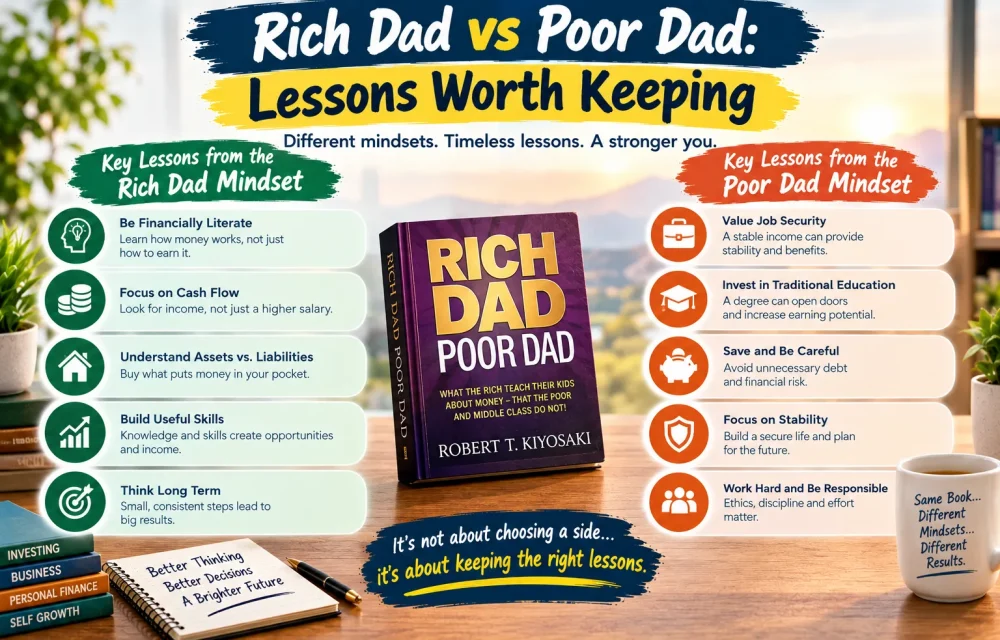
Rich Dad vs Poor Dad is more than a comparison between two fictional father figures. In Robert Kiyosaki’s Rich Dad Poor Dad, the two dads represent different ways of thinking about money, work, education, risk, and financial independence.
One mindset places greater emphasis on traditional education, job security, earning a stable income, and saving. The other places more emphasis on financial education, ownership, cash flow, building assets, and creating greater financial independence.
The important question isn’t simply which “dad” is right. It’s about understanding the ideas behind both approaches, recognizing their strengths and limitations, and deciding which lessons can help you make better financial decisions today.
What is the “Rich Dad vs Poor Dad” Mindset?
In Rich Dad Poor Dad, Kiyosaki presents two father figures who give him very different advice about money. His biological father represents the more traditional path: study hard, get a good education, find a secure job, work your way up, and build financial stability. His best friend’s father represents a different approach. He places greater emphasis on financial education, business ownership, investing, and understanding how money moves.
Kiyosaki uses these two characters as contrasting examples of financial thinking. The comparison is therefore less about income and more about the beliefs that influence financial decisions. This is important because having a high income doesn’t automatically mean someone is financially independent. Likewise, having a modest income doesn’t prevent someone from developing strong financial habits.
The real lesson is to become more conscious of the financial assumptions guiding your decisions.
Assets vs. Liabilities: A Different Way to Look at Wealth
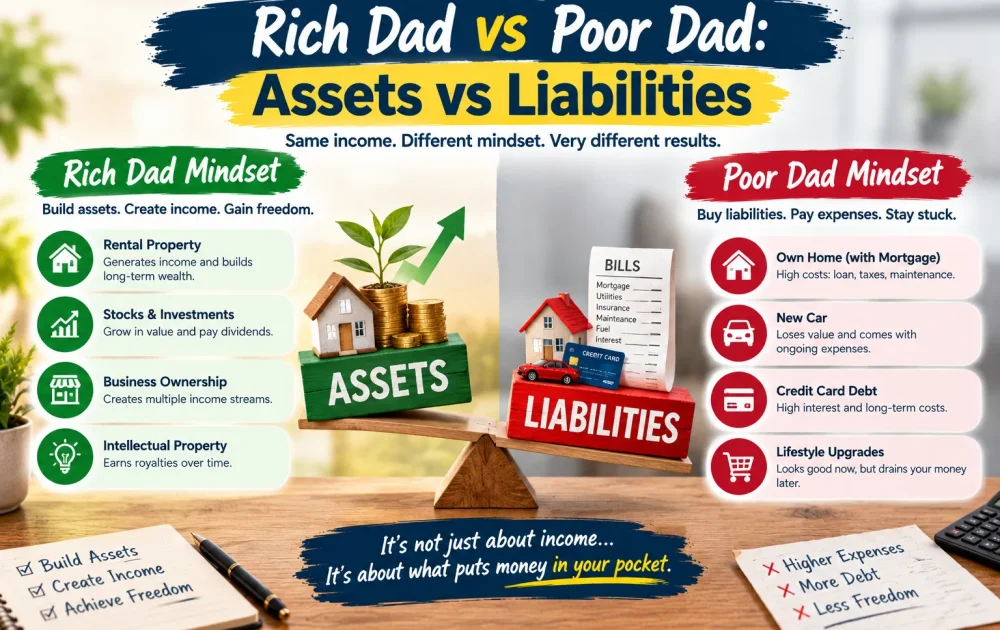
One of the most memorable ideas in Rich Dad Poor Dad is the distinction between assets and liabilities. In conventional accounting, an asset is something of economic value that a person or business owns.
Kiyosaki uses a simpler cash-flow-oriented definition: an asset puts money into your pocket, while a liability takes money out. This isn’t a replacement for formal accounting terminology. It is a mental model designed to make readers think about the cash-flow consequences of what they buy.
For example:
- A rental property generating positive cash flow may function as an income-producing asset.
- A business that consistently produces profit can contribute to your asset base.
- Investments may generate income or appreciate in value.
- A car generally creates ongoing expenses such as fuel, insurance, maintenance, and depreciation.
- A large home can create substantial mortgage, tax, maintenance, and other costs.
The useful question isn’t simply:
“Is this something I own?”
It is:
“How does this affect my cash flow and long-term financial position?”
That’s one of the strongest ideas in the rich vs poor dad framework.
“I Can’t Afford It” vs. “How Can I Afford It?”
Another memorable lesson is the difference between saying:
“I can’t afford it.”
and asking:
“How can I afford it?”
The first statement can end the thinking process. The second encourages you to examine possibilities. However, this idea should not be interpreted as a reason to buy things you cannot afford. Asking “How can I afford it?” should lead to better questions:
- Can I increase my income?
- Can I reduce unnecessary expenses?
- Can I save for it?
- Can I develop a valuable skill?
- Can I find a cheaper alternative?
- Is the purchase even necessary?
Used this way, the lesson is less about positive thinking and more about problem-solving.
Rich Dad vs Poor Dad: Working for Money vs. Building Financial Independence
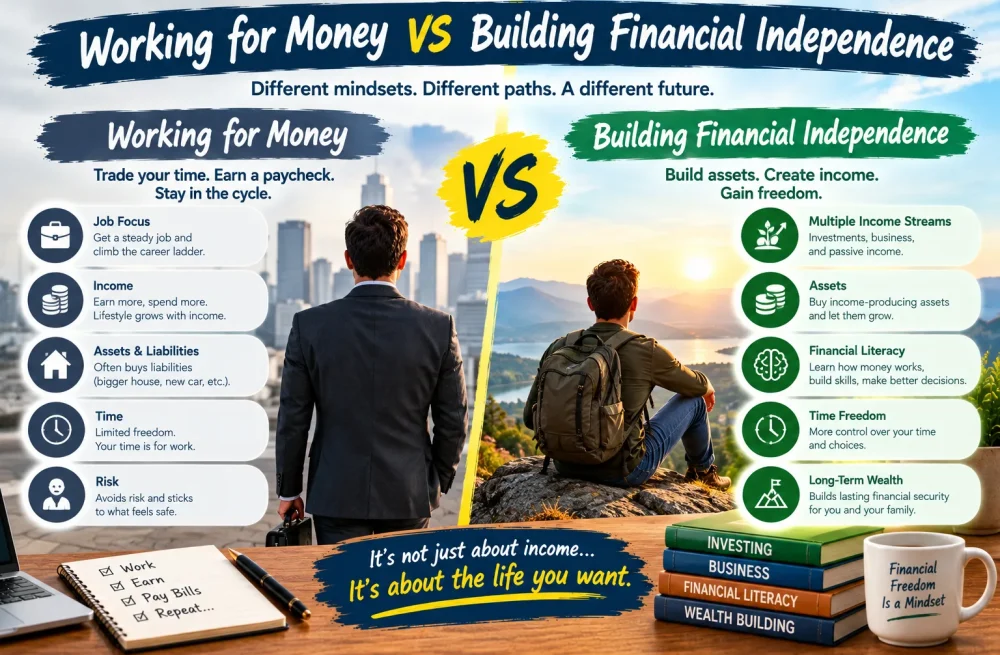
Kiyosaki famously discusses what he calls the “rat race” — a cycle in which people earn money, pay expenses, increase their lifestyle, and then need to keep earning more. The traditional mindset may focus heavily on getting a better job and increasing salary.
The alternative mindset asks:
“How can I build something that produces value beyond my immediate labor?”
That could mean:
- Building a business
- Developing investments
- Creating intellectual property
- Learning valuable skills
- Building multiple sources of income
But there is an important distinction here:
Having a job isn’t automatically a poor financial decision.
A stable job can provide income, experience, benefits, skills, and capital for future investments. Employment and entrepreneurship don’t have to be enemies. The more useful lesson is to avoid becoming completely dependent on a single source of income without developing your financial knowledge.
Why Financial Education Matters
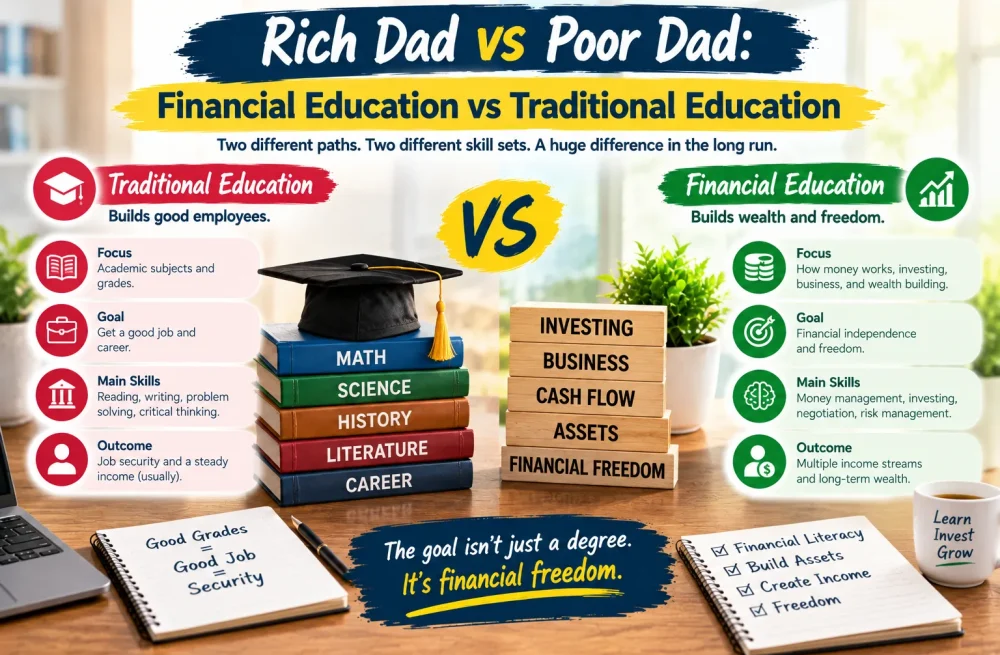
Kiyosaki repeatedly argues that traditional education doesn’t necessarily teach people how money works. Someone can have excellent academic qualifications and still struggle with:
- Budgeting
- Debt
- Investing
- Taxes
- Cash flow
- Risk
- Financial statements
- Long-term wealth planning
The rich dad mindset therefore places financial literacy alongside academic education. This doesn’t mean formal education is useless. A degree, professional qualification, or technical skill can be extremely valuable.
The stronger interpretation is:
Academic education and financial education solve different problems.
Ideally, you develop both.
Mind Your Own Business
One of Kiyosaki’s recurring ideas is to “mind your own business.” He doesn’t necessarily mean quitting your job and opening a company tomorrow. The idea is to distinguish between your job and your asset-building activities.
For example, someone might work as a teacher, accountant, engineer, manager, or designer while simultaneously building savings, investments, skills, or a small business.
Your job can provide the income that helps you build your financial foundation. This makes the idea more practical for ordinary readers: you don’t have to choose between employment and financial independence.
Work to Learn, Not Just to Earn
One of the most practical lessons from Rich Dad Poor Dad is to think about the skills a job can teach you. A position might provide experience in:
- Sales
- Communication
- Leadership
- Negotiation
- Marketing
- Management
- Accounting
- Customer service
These skills can become valuable later, even if the original job wasn’t your dream career. This is particularly useful for younger people who are still deciding what they want to do.
Instead of asking only:
“How much does this job pay?”
you can also ask:
“What will I learn here that could make me more valuable later?”
How the Rich vs Poor Dad Mindset Looks at Risk
The book encourages readers to become more comfortable with financial risk. But this idea needs to be interpreted carefully. Taking more risk does not automatically produce better financial results. The useful lesson is to understand risk rather than blindly avoid it or blindly chase it. Before making an investment or starting a business, you should consider:
- What could I lose?
- What could I realistically gain?
- How likely are different outcomes?
- Do I understand what I’m investing in?
- Can I afford the potential loss?
- What information am I missing?
Financial education should make you more thoughtful about risk, not reckless.
Taxes and Financial Rules
Rich Dad Poor Dad also encourages readers to understand how taxes, businesses, and financial structures can affect wealth. This is an interesting area, but readers should be careful with simplified statements about taxation.
Tax rules vary by country and can change over time. A strategy that makes sense for a business owner in one country may not make sense for an employee or investor elsewhere.
The practical lesson is therefore:
Learn the financial rules that apply to your own situation.
Don’t treat a general concept from a book as personalized tax or investment advice. For complicated decisions, qualified accountants, tax professionals, or financial advisers can provide guidance appropriate to your circumstances.
The Five Mental Roadblocks
Kiyosaki also discusses psychological obstacles that can interfere with financial progress. These include:
Fear
Fear of losing money can prevent people from learning about investing or taking reasonable opportunities.
Cynicism
Automatically assuming that every opportunity is a scam can prevent useful investigation. But healthy skepticism is still important.
Laziness
Being constantly busy doesn’t necessarily mean you’re making financial progress. Learning how money works requires deliberate effort.
Bad Habits
Small spending and saving habits can have significant long-term effects.
Arrogance
Assuming you already know everything can prevent you from learning new financial concepts.
These obstacles aren’t exclusive to people with low incomes. Anyone can struggle with them.
What Does "Rich vs Poor Dad" Really Teach?
After removing some of the book’s more controversial claims, the central message becomes easier to understand. The rich vs poor dad framework encourages readers to:
- Become financially literate.
- Think about cash flow.
- Understand what they own and what it costs them.
- Develop valuable skills.
- Think beyond their salary.
- Learn about investing and business.
- Understand financial risk.
- Build assets over time.
- Avoid unnecessary lifestyle inflation.
- Take greater responsibility for their financial decisions.
These are useful principles even if you don’t agree with every argument Kiyosaki makes.
A Balanced Look at the Rich Dad Philosophy
Rich Dad Poor Dad has attracted both strong supporters and strong critics.
Supporters appreciate its ability to make financial concepts accessible to ordinary readers. The book encourages people to think about financial education, cash flow, ownership, and long-term independence.
Critics argue that some of its financial concepts are oversimplified and that certain stories and claims should not be treated as detailed financial evidence.
Both perspectives are worth considering.
The book works best as an introduction to financial thinking, rather than a complete financial education. You shouldn’t read it and assume that every investment, tax strategy, or business idea mentioned will work for you. Instead, use it to generate better questions.
Is the Rich vs Poor Dad Mindset Still Relevant Today?
The financial world has changed considerably since Rich Dad Poor Dad was first published in 1997. Today, people have access to online businesses, digital products, low-cost investing platforms, financial education resources, and many different career paths.
At the same time, people face their own challenges, including inflation, debt, changing employment conditions, rising living costs, and financial uncertainty. That makes financial literacy arguably more important — but it doesn’t mean every recommendation from a book published decades ago should be followed literally.
The best approach is to separate the timeless questions from the dated assumptions. Ask:
How can I increase my financial knowledge?
How can I manage my money better?
How can I build long-term financial security?
How can I develop skills that increase my earning potential?
Those questions remain useful regardless of the decade.
How to Start Developing a Better Money Mindset
You don’t need to quit your job, start a company, or make a risky investment tomorrow. Start small.
1. Track Your Money
For one month, record your income and expenses.
Find out where your money actually goes.
2. Learn Basic Financial Terms
Understand concepts such as:
- Assets
- Liabilities
- Cash flow
- Income
- Expenses
- Debt
- Interest
- Risk
- Return
3. Examine Your Purchases
Before buying something expensive, ask whether it improves your financial position or simply increases your expenses.
4. Build Valuable Skills
Choose skills that can improve your career, business, or earning potential.
5. Learn Before You Invest
Don’t invest simply because someone promises high returns.
Understand what you’re buying, the risks involved, and whether it fits your financial situation.
6. Think Long Term
Building financial security usually takes time.
Focus on consistent decisions rather than looking for shortcuts.
Final Thoughts on the Rich Dad vs Poor Dad Mindset
The most useful lesson from Rich Dad Poor Dad isn’t that one father was right and the other was wrong. It’s that the way you think about money influences the decisions you make with money.
- A stable job can be valuable.
- Education can be valuable.
- Saving can be valuable.
- Investing can be valuable.
- Entrepreneurship can be valuable.
- Financial literacy helps you understand how these pieces can work together.
The rich vs poor dad comparison is therefore best viewed as a framework for questioning your assumptions.
Instead of automatically thinking:
“I work, earn, spend, and repeat,”
you can begin asking:
“What can I learn, build, own, or improve that could strengthen my financial future?”
You don’t need to reject the traditional path completely. Take the work ethic, education, responsibility, and stability that make sense for you. Add financial literacy, long-term thinking, and ownership where appropriate. That balanced approach is more useful than simply trying to become a “rich dad.”
The Bottom Line
Rich Dad Poor Dad is not a complete financial plan, and it shouldn’t be treated as one. But as a conversation starter about financial literacy, assets, cash flow, work, risk, and ownership, it can still provide valuable ideas.
Read it critically.
Keep the principles that help you think more clearly.
Question the claims that seem too simple.
Then do your own research before making real financial decisions.
The goal isn’t to think like a rich person simply because the book says so. The goal is to become better at thinking about money.
Ready to Improve the Way You Think About Money?
You don’t have to change your entire financial life overnight. Start with one simple step: understand where your money is going, learn one new financial concept, and make one better financial decision this week.
If you enjoy practical ideas from books about money, mindset, productivity, and personal growth, keep exploring SmartGrowthBooks for thoughtful summaries, reviews, and lessons you can apply to everyday life.
Don’t just read better ideas. Put the useful ones to work.
Disclaimer: This article is for educational and informational purposes only. It discusses ideas presented in Robert Kiyosaki’s book and is not financial, investment, tax, or legal advice. Always conduct your own research and consider consulting an appropriately qualified professional before making financial decisions.
About the Author
Muhammad Ajmal
Founder & Book Summary Writer at SmartGrowthBooks
Muhammad Ajmal researches and writes practical book summaries focused on self-help, productivity, psychology, personal finance, motivation, and personal growth.
This Summary is published on September 2026.
Related Book Summaries
Stay Smarter Every Week
Get practical book summaries, productivity tips, and self-improvement insights delivered to your inbox.