
7 Habits of Highly Effective People Summary: Key Lessons
Author: Stephen R. Covey
Published: 2004
Pages: 384
Genre: Personal Development, and Business
Reading Time: 12 Minutes
Table of Contents
ToggleIntroduction
If you are looking for a 7 habits of highly effective people summary, Stephen R. Covey’s central message is worth understanding: lasting effectiveness begins with the way you think, make decisions, and treat other people. Rather than offering a collection of quick productivity tricks, The 7 Habits of Highly Effective People presents a principle-based approach to personal responsibility, priorities, relationships, and continuous growth.
First published in 1989, the book introduces seven habits that Covey organizes into three stages: personal independence, effective relationships, and renewal. Its ideas are intended to work together, not as seven unrelated tips. This guide explains each habit in straightforward language, highlights the main lessons, and considers who may benefit from reading the book today.
The 7 Habits at a Glance (Outline)
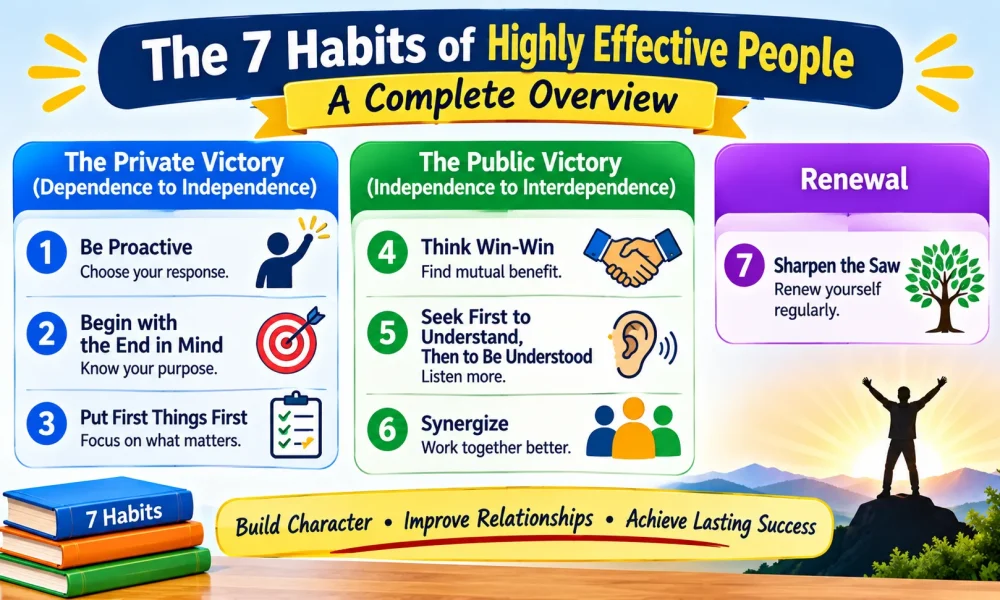
Covey describes a progression from dependence to independence and then to interdependence. In simple terms, this means learning to manage yourself before trying to work effectively with others.
The Private Victory — Personal Effectiveness
- Be Proactive: Take responsibility for your choices and focus on what you can influence.
- Begin with the End in Mind: Decide what matters to you and use that direction to guide your decisions.
- Put First Things First: Give time to important priorities instead of reacting to every demand.
The Public Victory — Working Effectively With Others
- Think Win-Win: Look for solutions that respect the interests of everyone involved.
- Seek First to Understand, Then to Be Understood: Listen carefully before presenting your own position.
- Synergize: Use different perspectives and strengths to create better solutions together.
Renewal
- Sharpen the Saw: Make time to renew your physical, mental, social, and spiritual well-being.
The first three habits focus on self-management. The next three apply those principles to relationships and cooperation. The seventh supports the whole process by encouraging regular renewal.
Another important idea in the book is the P/PC Balance. Covey uses production to describe the results you want and production capability to describe the ability or resources that produce those results. His point is that concentrating only on immediate output can damage the capacity needed to keep producing good results. For example, working constantly without rest may help you finish today’s tasks, but it can undermine your health and performance over time.
Habit 1: Be Proactive
The first habit is about taking responsibility for your responses. Covey distinguishes between what happens to us and how we choose to respond. You cannot control every event, another person’s behavior, or unexpected difficulties, but you can often decide what action to take next.
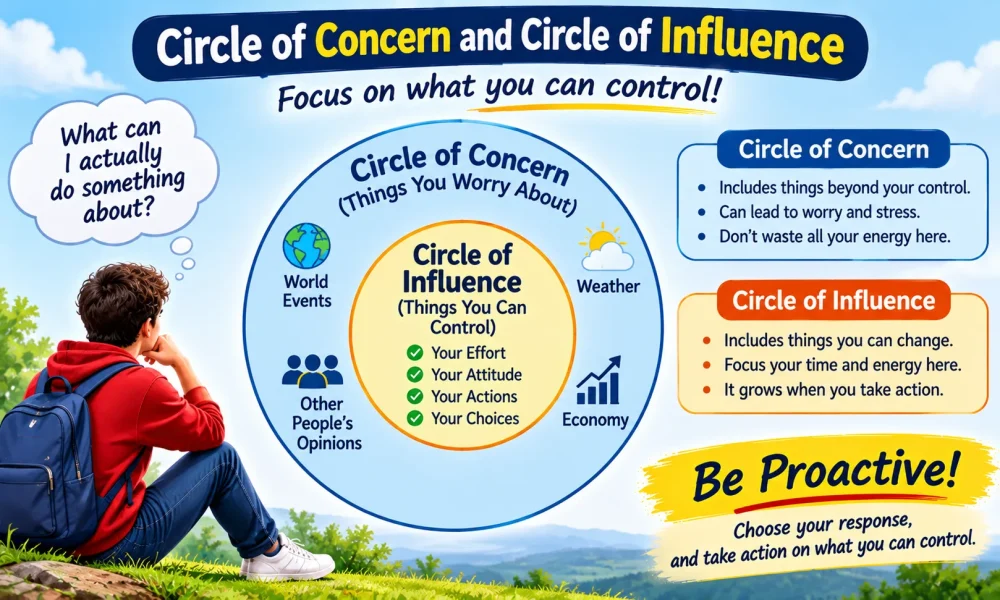
He introduces the Circle of Concern and the Circle of Influence to explain this idea. Your Circle of Concern includes things that matter to you but may be outside your control, such as economic conditions or other people’s opinions. Your Circle of Influence includes matters where your choices can make a difference, such as your preparation, communication, and daily actions.
A reactive response focuses heavily on what is wrong or on what someone else should change. A proactive response asks, “What can I do about this situation?”
This does not mean pretending that serious problems are easy to solve. It means directing your effort toward useful choices rather than spending all your energy on things you cannot change.
Key lesson: Take responsibility for your next response. You may not control the situation, but you can often choose a constructive step.
Habit 2: Begin with the End in Mind
Habit 2 is about direction. Before committing your time and effort to something, consider what you actually want to achieve and what kind of person you want to become.
Covey uses the image of a funeral to encourage readers to think about the legacy they would like to leave. What would you hope family members, friends, and colleagues remember about you? The exercise shifts attention away from short-term recognition and toward values, relationships, and meaningful contributions.
One practical tool is a personal mission statement. This is a written expression of your values, priorities, and longer-term direction. It does not need to sound impressive or contain perfect wording. Its purpose is to help you make decisions that are consistent with what matters to you.
For example, someone who values family, learning, and health might use those priorities when deciding how to spend evenings or accept additional work. The statement becomes a guide, not a rigid set of rules.
Covey also describes creation as happening twice: first mentally and then physically. A plan or vision comes before the actions that bring it into reality.
Key lesson: Decide where you want to go before filling your schedule with activities. Clear direction makes it easier to recognize which opportunities deserve your attention.
Habit 3: Put First Things First
Habit 3 turns the direction established in Habit 2 into everyday action. Knowing what matters is useful, but it has limited value if your time is always consumed by interruptions and urgent demands.
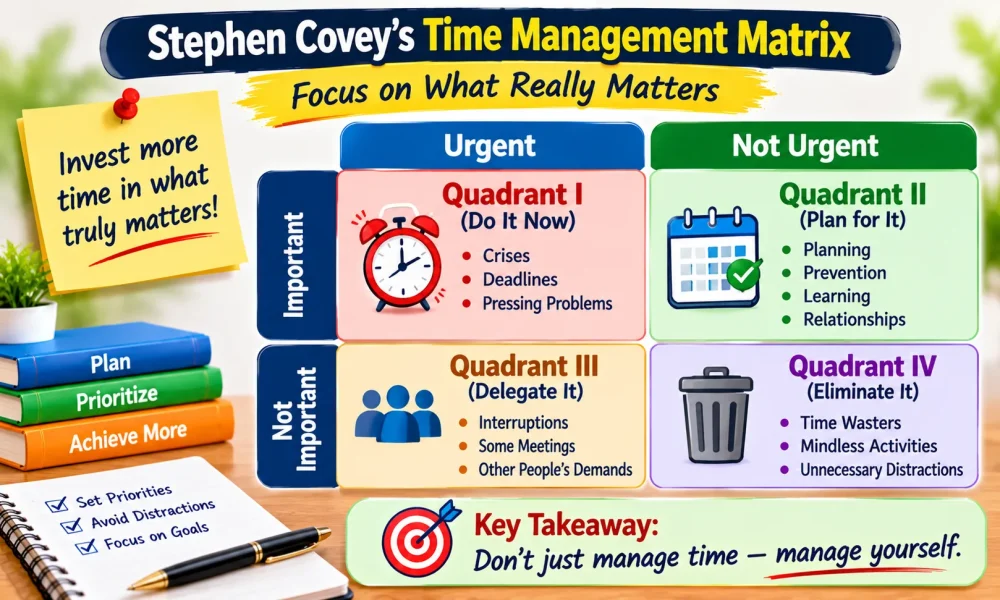
Covey’s Time Management Matrix sorts activities according to two questions: are they urgent, and are they important?
- Quadrant I — Urgent and Important: Crises, pressing deadlines, and problems that need immediate attention.
- Quadrant II — Important but Not Urgent: Planning, prevention, learning, exercise, and relationship-building.
- Quadrant III — Urgent but Not Important: Interruptions and requests that demand attention but may not support your main priorities.
- Quadrant IV — Neither Urgent nor Important: Activities that consume time without offering much value.
Covey places particular emphasis on Quadrant II. These activities may not demand attention today, but they can prevent future problems and support long-term goals.
Imagine a student who reviews lessons regularly rather than waiting until the night before an exam. Regular review may not feel urgent, but it can reduce the pressure of last-minute preparation. The same principle applies to planning work, maintaining health, and staying in touch with important people.
Habit 3 is not simply about using a better calendar. It is about making choices that reflect your priorities, including learning to say no to some requests.
Key lesson: Do not let urgency decide everything for you. Protect time for important activities before they become emergencies.
Habit 4: Think Win-Win
The first three habits focus on personal effectiveness. Habit 4 applies the same principle-based thinking to relationships and agreements.
Covey presents Win-Win as an approach in which people look for outcomes that respect the interests of everyone involved. It is different from trying to defeat another person, giving in simply to avoid disagreement, or accepting an arrangement that leaves both sides dissatisfied.
Win-Win does not mean that everyone gets exactly what they initially requested. It requires honest discussion, consideration, and a willingness to search for a workable solution.
Covey also discusses Win-Win or No Deal. When a mutually acceptable agreement cannot be reached, people may choose not to proceed rather than force a deal that damages the relationship.
This habit is useful in workplaces, families, partnerships, and negotiations. For instance, a manager and employee may disagree about a deadline. Instead of insisting on an unrealistic commitment or accepting poor-quality work, they can discuss the workload and agree on a more realistic plan.
A Win-Win approach still requires boundaries. Cooperation should not mean ignoring your own needs or accepting unfair treatment.
Key lesson: Aim for agreements that respect both sides. A successful outcome should not depend on treating another person as an opponent.
Habit 5: Seek First to Understand, Then to Be Understood
Habit 5 focuses on communication, especially listening. Many conversations become frustrating because people prepare their replies before they have understood what the other person is saying.
Covey describes this tendency as listening through our own experiences and assumptions. We may respond with advice, judgment, or a similar story without first understanding the speaker’s situation.
He recommends empathic listening: making a genuine effort to understand another person’s perspective, including the feelings and meaning behind their words. This does not require agreeing with everything they say. It means listening carefully before deciding how to respond.
Consider a colleague who says they are struggling with a project. Immediately telling them to manage their time better may miss the real issue. They may lack information, have conflicting responsibilities, or need support from another team. Asking questions and reflecting back what you have understood can reveal the actual problem.
The second part of the habit is being understood. After listening, explain your own ideas clearly and respectfully. Covey’s sequence is important: understanding should come before trying to persuade.
Key lesson: Listen to understand, not merely to prepare your reply. People are more likely to engage constructively when they feel their perspective has been taken seriously.
Habit 6: Synergize
Habit 6 is about creative cooperation. Covey uses synergy to describe what can happen when people combine different strengths, experiences, and viewpoints to produce a better result than they might have achieved independently.
Synergy is more than simply dividing tasks among team members. It involves valuing differences and remaining open to ideas that challenge your first solution.
Imagine a small business team planning a new service. One member understands customer needs, another understands technology, and another has experience with budgeting. If they listen to one another and build on their different knowledge, they may develop an approach that none of them would have created alone.
This process depends on the earlier habits. Win-Win thinking helps people respect each other’s interests, while empathic listening helps them understand different viewpoints. Without trust and genuine listening, disagreement can turn into competition rather than collaboration.
Synergy does not guarantee that every group decision will be better. It requires openness, thoughtful discussion, and a shared willingness to find a stronger alternative.
Key lesson: Differences can be useful resources. Instead of asking whose idea should win, ask whether the group can create a better solution together.
Habit 7: Sharpen the Saw
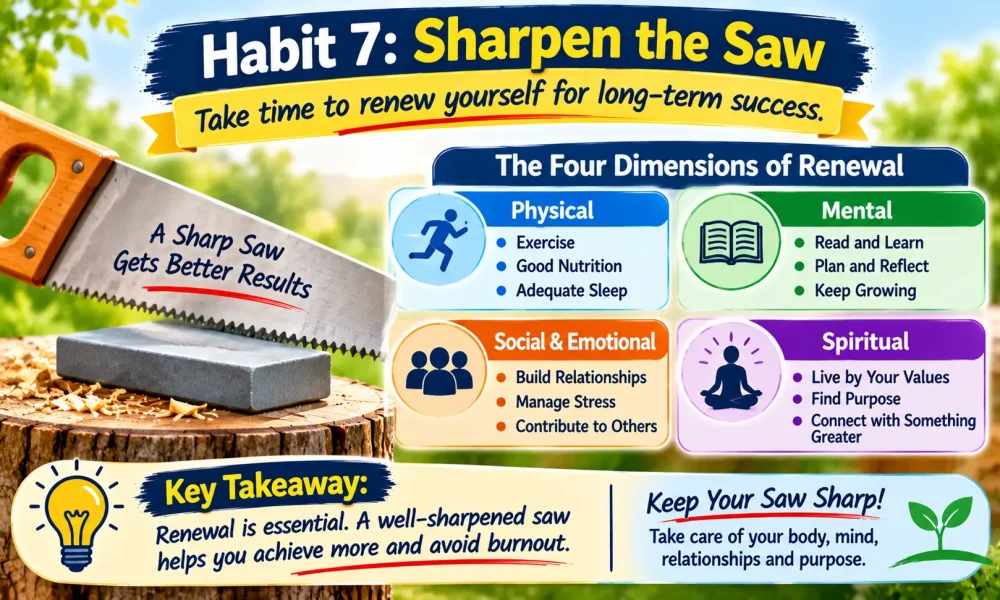
The final habit focuses on renewal. Covey uses the image of a person cutting wood with a saw that has become dull but refusing to stop and sharpen it. The person is so focused on continuing the work that they neglect the tool needed to do it well.
In this comparison, the saw represents you. Your ability to work, make decisions, and maintain relationships depends partly on how well you look after yourself.
Covey describes four dimensions of renewal:
- Physical: Exercise, nutrition, sleep, and caring for your body.
- Mental: Reading, learning, writing, and developing your thinking.
- Social and Emotional: Building relationships, practicing empathy, and contributing to others.
- Spiritual: Reflecting on values, purpose, and the principles that guide your life. This may involve prayer, meditation, time in nature, or another meaningful practice.
The exact activities will differ from person to person. The important point is to avoid treating renewal as something you do only after becoming exhausted.
For example, a demanding work schedule may leave little room for exercise, reading, or family time. Habit 7 encourages you to make these areas part of your routine rather than postponing them indefinitely.
Key lesson: Sustainable effectiveness requires renewal. Looking after your capacity is part of doing meaningful work, not a distraction from it.
Final Takeaways: Key Notes From the 7 Habits Book Summary
The main lessons of Covey’s framework can be condensed into a few points:
- Take responsibility: Focus on the choices and actions within your influence.
- Choose your direction: Identify your values and use them to guide decisions.
- Protect important priorities: Give time to meaningful work before it becomes urgent.
- Build mutual trust: Look for fair outcomes rather than short-term victories.
- Listen before responding: Understand another person’s perspective before presenting your own.
- Cooperate creatively: Use different strengths to find better solutions.
- Make renewal a routine: Maintain the physical, mental, social, and spiritual resources that support your life.
The habits are connected. Personal responsibility supports clearer priorities; clearer priorities make it easier to work with others; and renewal helps sustain the process.
Who Should Read The 7 Habits of Highly Effective People?
This book may be especially useful if you:
- Feel busy but struggle to identify your most important priorities.
- Want to become more responsible for your decisions and actions.
- Manage people or work in a team.
- Want to improve communication and relationships.
- Prefer a broad personal-development framework over a collection of quick productivity techniques.
Students, professionals, managers, parents, and people reassessing their long-term goals may find ideas worth considering. The value you get will depend on how thoughtfully you apply the principles to your own circumstances. For more ways to organise your work and protect time for important tasks, explore our productivity tips.
Who Should Skip It?
You may want a different book if you are looking for short, step-by-step instructions for a specific task, such as organizing an inbox or planning a single workday. Covey’s approach is broad and principle-based, so readers seeking immediate technical instructions may find it less practical.
Some readers may also find the language philosophical or the examples dated. The book’s emphasis on character and principles may not appeal to everyone, and its framework should not be treated as a complete solution to every personal, professional, or organizational problem.
It is also important to recognize that personal choices matter, but circumstances and structural barriers can limit what people are able to change. Being proactive does not mean blaming individuals for every difficulty they experience.
Final Thoughts
The 7 Habits of Highly Effective People is best understood as a framework for making more deliberate choices, managing priorities, and building healthier relationships. Its central message is not that you can control every outcome, but that you can become more intentional about the way you respond and act.
If one idea is worth taking from this 7 habits of highly effective people book summary, it is that effectiveness develops through repeated choices. Start with one habit that addresses a real challenge in your life, put it into practice, and reflect on what changes. You do not have to master all seven at once.
You don’t need to change all seven habits at once. Choose one idea that addresses a challenge in your life, put it into practice this week, and observe what changes. If you want to explore another practical approach to building better routines, read our Atomic Habits book summary next. And if this summary helped you understand Covey’s ideas, share it with someone who could benefit from them.
About the Author
Muhammad Ajmal
Founder & Book Summary Writer at SmartGrowthBooks
Muhammad Ajmal researches and writes practical book summaries focused on self-help, productivity, psychology, personal finance, motivation, and personal growth.
This Summary is published on November 2026.
Related Book Summaries
Stay Smarter Every Week
Get practical book summaries, productivity tips, and self-improvement insights delivered to your inbox.