
Table of Contents
ToggleIntroduction
Good study habits are rarely built through motivation alone. Many students create ambitious timetables, study intensely for a few days, and then struggle to maintain the routine once classes, assignments, family responsibilities, and distractions compete for their attention. The solution is not always to study longer. Often, it is to design a routine that is easier to start and repeat.
James Clear’s Atomic Habits provides a useful framework for building consistent study habits for students. Its central message is that small actions, repeated regularly, can gradually become part of everyday life. However, building a study routine is only half the challenge. Students also need learning techniques that help them understand and remember what they study.
This guide combines the habit-building ideas from Atomic Habits with research on effective learning. You will discover good study habits to adopt, learn how to create a realistic study schedule, explore practical study habits examples, and identify bad habits that may be holding you back.
If you want to explore the book’s main ideas in more detail, read our complete breakdown of James Clear’s Atomic Habits.

Good Study Habits Backed by Atomic Habits
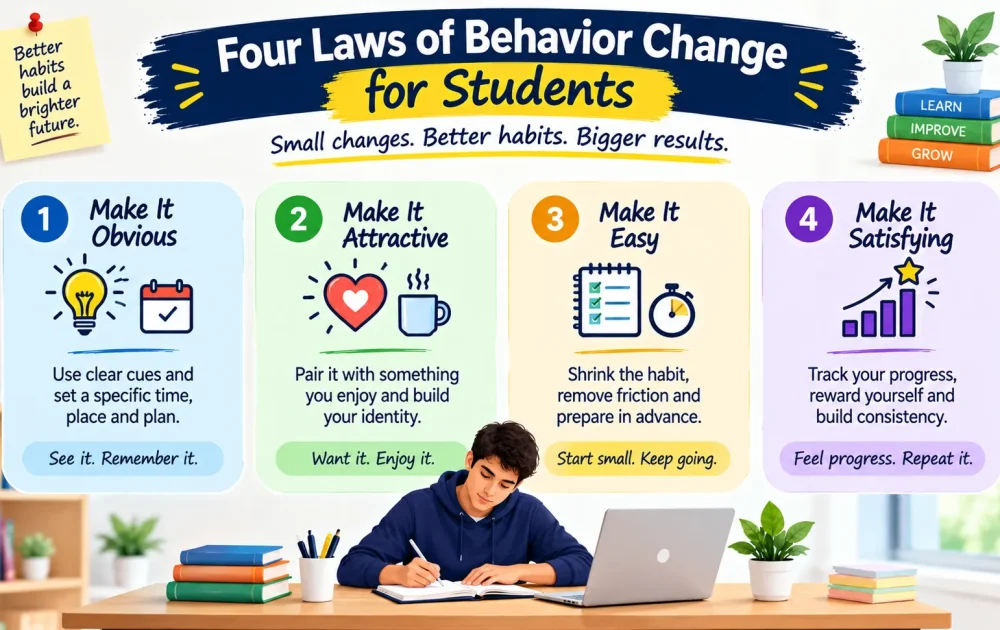
Clear organizes habit-building around four laws of behavior change: make it obvious, make it attractive, make it easy, and make it satisfying. These principles can help students establish a reliable routine. Learning research adds another important question: once you begin studying, what should you actually do?
The most useful approach combines both. Build a routine that is easy to repeat, then use the time to practise recalling information, solving problems, and reviewing material across multiple days.
1. Make Studying Obvious
A habit becomes easier to remember when it has a clear cue. Instead of waiting for the right mood, decide exactly when and where you will study.
For example, replace “I will study mathematics every day” with “After dinner, I will solve five mathematics questions at my desk.” The second statement identifies a time, a situation, and a specific action.
Clear calls this kind of plan an implementation intention. Research by Peter Gollwitzer and Paschal Sheeran found that specifying when, where, and how to act can improve goal achievement across a range of situations.
You can also use habit stacking by connecting studying to an existing routine:
- After breakfast, I will review my flashcards.
- After returning from class, I will organize my lecture notes.
- After dinner, I will practise questions from my most difficult subject.
Try this: Choose one existing daily activity and attach a small study action to it. Keep the cue consistent enough that you do not need to decide when to begin every day.
2. Make Studying Attractive
Studying can feel less appealing when it is associated with stress, boredom, or an overwhelming workload. Making the experience more inviting may help you begin more willingly.
One idea from Atomic Habits is temptation bundling: pairing an activity you want to do with an activity you need to do. For instance, you might reserve a favourite drink for your study session or use a comfortable library environment that helps you focus.
Be careful not to turn every session into a reward that requires a purchase. You can make studying more appealing through simple changes, such as using a clean desk, setting a clear objective, or studying alongside a friend who takes the work seriously.
Another useful idea is identity. Instead of repeatedly telling yourself, “I am bad at studying,” think about the behaviour you want to practise: “I am becoming a student who reviews material consistently.”
You do not have to believe that statement perfectly from the beginning. Each time you complete a realistic study session, you give yourself evidence that you can follow through.
Try this: Before your next session, choose one small change that makes the environment more pleasant without adding a distraction.
3. Make Studying Easy to Start
Large tasks can feel intimidating. “Finish the entire chemistry chapter” may seem difficult to begin, especially after a tiring day. A smaller action removes some of that initial resistance.
Clear’s Two-Minute Rule recommends reducing a new habit to a version that takes about two minutes or less to start. Examples include opening your textbook, writing the first question, or reviewing one flashcard.
The purpose is not to limit every study session to two minutes. It is to make beginning easier. Once you have started, you can continue with a longer session if your time and energy allow.
Prepare your environment in advance, too. Keep your books, notes, stationery, and charger ready. Write down the next task before you finish the previous session so you do not waste time deciding what to do later.
However, making a habit easy is different from making learning effortless. Some useful learning activities require concentration and mental effort.
A review by John Dunlosky and colleagues identified practice testing and distributed practice as especially useful learning techniques. Rather than simply rereading a page, close the book and try to explain the main idea from memory. Then check your answer and correct any gaps.
Try this: Start with a two-minute action, then spend the rest of your planned session answering questions, explaining ideas in your own words, or solving problems.

4. Make Progress Satisfying
The benefits of studying may not become obvious until an exam, assignment, or assessment. A small, immediate way to recognize progress can help you maintain the routine.
Use a calendar, notebook, or habit tracker to record completed sessions. You might track whether you completed your planned practice questions rather than simply counting hours spent at a desk.
Be realistic about what the tracker measures. A long session does not automatically mean effective learning, and a short session can still be valuable if it helps you practise a difficult concept.
Clear also encourages people not to miss twice. This is a useful reminder to resume a routine after a missed day rather than allowing one interruption to become a longer break. It should not be treated as a strict rule that makes rest, illness, or unavoidable responsibilities into failures.
Research on habit formation supports patience and repetition, not a universal deadline. A study by Phillippa Lally and colleagues found substantial variation in how long simple daily behaviours took to become more automatic. It did not establish a fixed number of days for every habit or every student.
Try this: Mark each completed session and review your progress weekly. If you miss a day, identify what interrupted the routine and decide how to make the next session easier to complete.
5. Use Active Recall and Spaced Practice
A reliable routine helps you sit down to study, but the technique you use during that time matters.
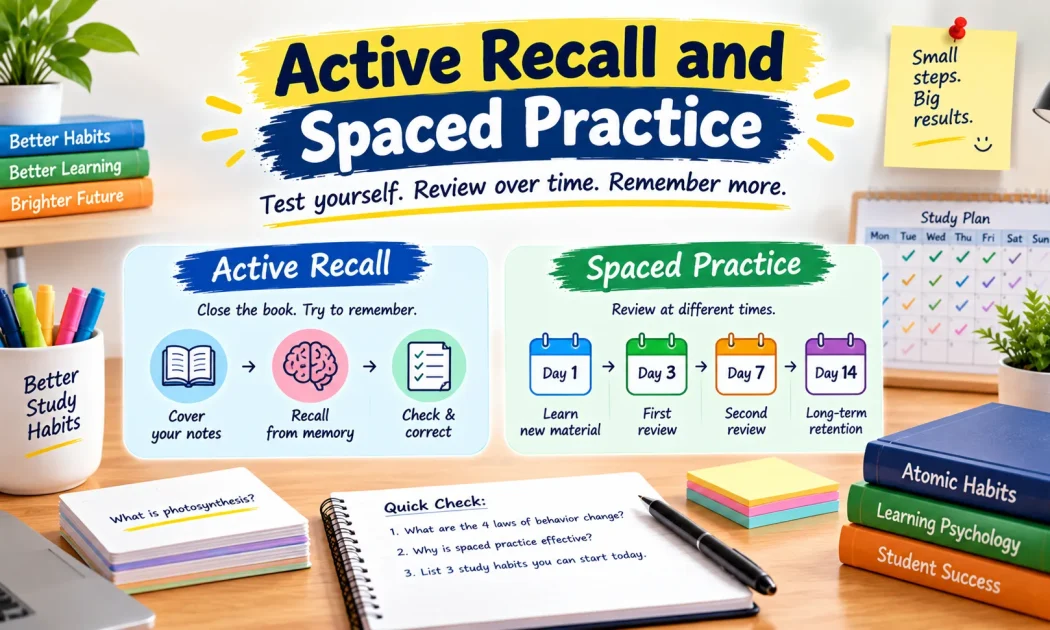
Active recall means attempting to retrieve information from memory instead of repeatedly looking at the answer. You can practise it by covering your notes, answering a question, writing down the main points of a lecture, or explaining a concept without looking at your textbook.
Spaced practice means reviewing material across separate sessions rather than concentrating all your studying into one long session immediately before an exam.
The Dunlosky review found strong support for practice testing and distributed practice across a range of learning conditions. It also noted that rereading and highlighting alone did not consistently produce the same benefits.
For example, after studying a biology topic, close your notes and draw the process from memory. Check the textbook, correct mistakes, and test yourself again a day or two later. For mathematics, attempt problems without looking at worked solutions first.
These techniques do not replace understanding. If you cannot explain a concept or solve a problem, return to the material, clarify the gap, and try again.
Try this: End each study session with three questions you should be able to answer from memory. Schedule a short review of those questions later in the week.
How to Create a Study Schedule
A study schedule should fit your actual life, not an ideal day in which nothing unexpected happens. The best study habits are the ones you can repeat alongside classes, sleep, meals, work, and other responsibilities.
Use this six-step method to create a practical schedule.
Step 1: Map Your Fixed Commitments
Write down your class times, work shifts, commuting, meals, sleep, and regular responsibilities. Then identify the available periods in which studying is realistic.
Do not assume that every free hour must become a study hour. Breaks and downtime help make a schedule sustainable.
Step 2: Choose a Consistent Time and Place
Pick a study slot that fits your daily routine. It might be after breakfast, after your last class, or after dinner.
Choose a place where you can concentrate, even if it is simply one corner of a shared room. If you cannot use the same place every day, keep the cue consistent—for example, starting after your evening meal.
Step 3: Start With a Manageable Session
Begin with a realistic amount of time, such as 20–30 minutes on a school day. If you can maintain that routine, gradually increase the duration or add another session when needed.
You do not need to copy someone else’s timetable. Your subjects, workload, energy, and deadlines determine how much study time is appropriate.
Step 4: Schedule Specific Tasks
Avoid vague entries such as “study history.” Give each session a clear purpose.
For example:
- Review the causes of a historical event and explain them from memory.
- Solve five algebra problems without checking the worked answers.
- Create flashcards for ten unfamiliar biology terms.
- Write a short outline for an upcoming essay.
Specific tasks make it easier to begin and to evaluate whether you completed the work.
Step 5: Spread Review Across the Week
Do not leave every subject until the night before an exam. Schedule brief reviews of previously covered material alongside new assignments.
For instance, you might review Monday’s lecture on Wednesday, answer practice questions on Friday, and revisit the most difficult points on Sunday.
The exact intervals can vary with the subject, difficulty, and exam date. The goal is to return to material over time, not to follow one supposedly perfect spacing formula.
Step 6: Review and Adjust Weekly
Spend about ten minutes at the end of the week asking:
- Which sessions did I complete?
- Which tasks took longer than expected?
- What distracted me most often?
- Which subjects need more attention next week?
- What change would make my schedule easier to follow?
Adjust your plan based on what actually happened. If you repeatedly miss a session because it is scheduled too late, move it to a more realistic time rather than blaming yourself.
Setting a small, specific goal can make it easier to decide what to do during your next study session.
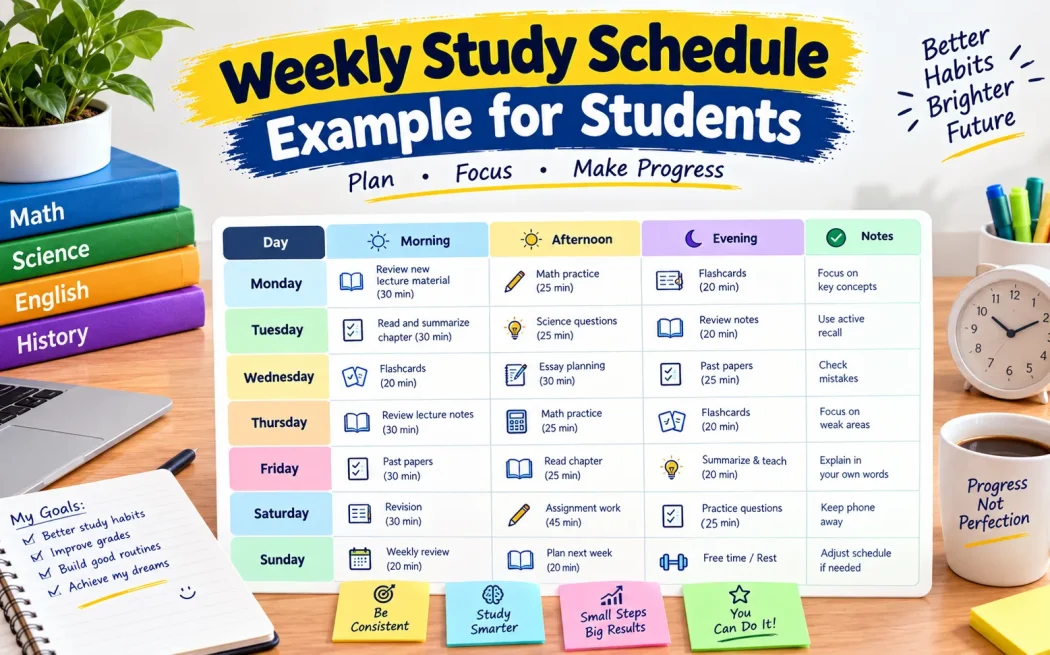
Study Habits Examples: A Sample Week
Here is a simple example you can adapt to your own commitments.
|
Day |
Suggested study task |
|
Monday |
30 minutes reviewing new lecture material and answering practice questions |
|
Tuesday |
25 minutes practising problems in a difficult subject |
|
Wednesday |
20 minutes reviewing older material using flashcards |
|
Thursday |
30 minutes completing an assignment or practising essay questions |
|
Friday |
A short review of the week’s most difficult topics |
|
Saturday |
A longer session for revision or unfinished work, if needed |
|
Sunday |
A 10-minute schedule review and planning session |
This is a starting point, not a rule that every student must follow. During exam periods, you may need more time; during busy weeks, a shorter routine may be more realistic.
Bad Study Habits to Break
Building good routines is only part of the process. You also need to recognize behaviours that make studying harder or use your time inefficiently. Clear’s framework suggests changing the cues and conditions that encourage unwanted habits rather than relying entirely on willpower.
1. Cramming Everything the Night Before
Cramming may feel productive because you cover a lot of material in a short time. However, concentrating all your review into one session leaves little opportunity to revisit information over several days.
Try instead: Divide the material into smaller tasks and schedule short review sessions before the exam. If you have already fallen behind, prioritize the most important topics and make a realistic plan rather than attempting an impossible all-night schedule.
2. Rereading and Highlighting Without Testing Yourself
Rereading can help you become familiar with a topic, and highlighting can help you identify key information. The problem is relying on these methods alone and assuming familiarity means mastery.
Try instead: After reading a section, close the book and write down the main ideas. Use practice questions to identify gaps, then return to your notes to correct them.
3. Studying With Your Phone Within Easy Reach
Messages, social media, and notifications can interrupt concentration. Even when you do not respond, the possibility of checking your phone may compete with the task in front of you.
Try instead: Silence notifications, place your phone out of reach, or use a website blocker during a planned study session. If you need your phone for learning, open only the tools required for that task.
4. Waiting Until You Feel Motivated
Motivation naturally changes from day to day. If you wait until you feel ready, important work can be delayed repeatedly.
Try instead: Use a small starting action. Open your notes, set a timer, or answer one question. You may continue after starting, but even a short session can help preserve the routine on a difficult day.
5. Giving Up After Missing One Session
An unexpected event, tiredness, or a demanding assignment can disrupt even a well-designed plan. Treating one missed session as proof that you cannot be consistent may turn a temporary interruption into a longer break.
Try instead: Resume at the next reasonable opportunity. If the same problem keeps recurring, adjust the schedule or reduce the starting task until the routine fits your circumstances.
6. Studying in a Distracting Environment
Trying to study beside a television, in a noisy room, or in a place associated with scrolling can make concentration more difficult.
Try instead: Choose a relatively quiet spot, keep only necessary materials nearby, and establish a clear beginning and end to each session. If your environment is outside your control, use practical alternatives such as a library, earplugs, or shorter focused sessions.
Breaking bad habits does not require perfect discipline. It often starts with making distractions less convenient and useful study actions easier to begin.
Small changes become more useful when you connect them to a repeatable routine, which is why productivity systems can help you manage your time more deliberately.
Who Should Read Atomic Habits for Study Habits for Students?
Atomic Habits may be especially useful if you know what you need to do but struggle to do it consistently. Students who repeatedly abandon timetables, delay starting assignments, or find it difficult to maintain routines may appreciate its emphasis on small actions, environmental cues, and gradual improvement.
The book can also help students who want to build routines beyond studying, such as regular reading, exercise, or preparing for the next day.
However, it is important to understand what the book does and does not offer. It is a habit-building framework, not a complete guide to memory, mathematics, essay writing, or exam preparation. Students should pair it with effective learning techniques and subject-specific instruction.
If ongoing anxiety, low mood, attention difficulties, or other challenges seriously affect your ability to study, a habit system may not be sufficient on its own. Seeking appropriate support from a qualified professional or your educational institution can be an important part of the solution.
For the original explanation of the habit-building framework, see James Clear’s work on Atomic Habits.
Final Thoughts: Build a Routine You Can Repeat
The most useful study habits for students are not necessarily the most demanding. They are the ones that help you begin, focus on meaningful work, and return consistently after interruptions.
Atomic Habits offers a practical way to design those routines: choose a clear cue, make the first step small, prepare a supportive environment, and recognize your progress. Research on learning adds another essential lesson: use your study time to retrieve information from memory and revisit it across multiple sessions.
You do not need to rebuild your entire timetable today. Choose one subject, one realistic time, and one small task. Write down when and where you will begin, then test the routine for a week and adjust it based on your experience.
Your next step: Choose a study slot for tomorrow, prepare the materials in advance, and write one specific task you can complete during that session. Start small, learn from what happens, and build from there.
About the Author
Muhammad Ajmal
Founder & Book Summary Writer at SmartGrowthBooks
Muhammad Ajmal researches and writes practical book summaries focused on self-help, productivity, psychology, personal finance, motivation, and personal growth.
This Summary is published on October 2026.
Related Book Summaries
Stay Smarter Every Week
Get practical book summaries, productivity tips, and self-improvement insights delivered to your inbox.