
Ray Dalio Principles Summary: Rules for Work and Life
Author: Ray Dalio
Published: 2017
Pages: 592
Genre: Business
Reading Time: 12 Minutes
Table of Contents
ToggleIntroduction
Some business books offer motivation. Others offer a framework for making decisions, learning from mistakes, and working more effectively with people. Ray Dalio’s Principles: Life and Work attempts to do the latter.
This Ray Dalio Principles summary explores how the founder of Bridgewater Associates turned lessons from his career into written rules for handling recurring problems. Instead of relying entirely on instinct, Dalio argues that people can improve their decisions by examining what happened, identifying the reasons, and developing principles to guide future choices.
If you are searching for a principles by Ray Dalio summary that respects your time, this guide covers the book’s main ideas, its five-step process, its approach to workplace culture, and its strengths and limitations.
The book is not a simple formula for guaranteed success. It is a detailed account of one person’s approach to thinking, management, and personal development. Some ideas are widely applicable; others require careful adaptation to your circumstances.
If you want to explore a more habit-focused approach to personal growth, read our Atomic Habits book summary to see how small routines can support lasting change.
Who Is Ray Dalio, and Why Did He Write Principles?
Ray Dalio founded Bridgewater Associates in 1975. The investment firm grew into one of the world’s largest hedge funds, and Dalio became known for his analytical approach to markets, decision-making, and organizational culture.
His experiences also included painful mistakes. One particularly important setback occurred in 1982, when he expected a severe economic downturn that did not unfold as he predicted. Dalio has described the financial and professional consequences of that mistake as a turning point in how he thought about being wrong and learning from others.
Rather than treating his judgment as automatically reliable, he began developing a system for recording lessons and applying them to future decisions.
Published in 2017, Principles: Life and Work brings together his personal story and the rules he developed over decades. Its central argument is that recurring problems become easier to handle when you understand their causes and establish principles for responding to them.
Principles Ray Dalio Summary: How the Book Is Organized
The book has three main parts.
Part One: Where I’m Coming From introduces Dalio’s background and explains how his experiences shaped his philosophy.
Part Two: Life Principles focuses on facing reality, setting goals, understanding differences between people, staying open-minded, and making better decisions.
Part Three: Work Principles applies these ideas to organizations, covering workplace culture, hiring, management, feedback, and improving business processes.
The distinction matters. The life principles can be useful to an individual trying to improve personal decisions. The work principles are especially relevant to people responsible for leading teams or shaping an organization.
You do not have to agree with every rule to benefit from the book. A more useful approach is to understand Dalio’s reasoning, test the ideas that seem relevant, and decide which ones work in your own environment.
Life Principles: The Heart of Dalio’s Rulebook
Embrace Reality and Learn From Pain
Dalio encourages readers to see situations as they are rather than as they wish them to be. Ignoring an uncomfortable fact may protect your feelings temporarily, but it can prevent you from addressing the actual problem.
One of his best-known ideas is “Pain + Reflection = Progress.” The practical meaning is straightforward: when something goes wrong, don’t stop at disappointment. Examine what happened and identify what you could do differently next time.
Imagine that you repeatedly miss deadlines. Blaming a busy schedule may explain part of the problem, but reflection might reveal that you underestimate how long tasks take or accept too many commitments. Once you identify the underlying cause, you can change your planning process.
Pain does not automatically produce improvement. Reflection, honest diagnosis, and a willingness to change are what make a setback useful.
The Five-Step Process for Achieving Goals
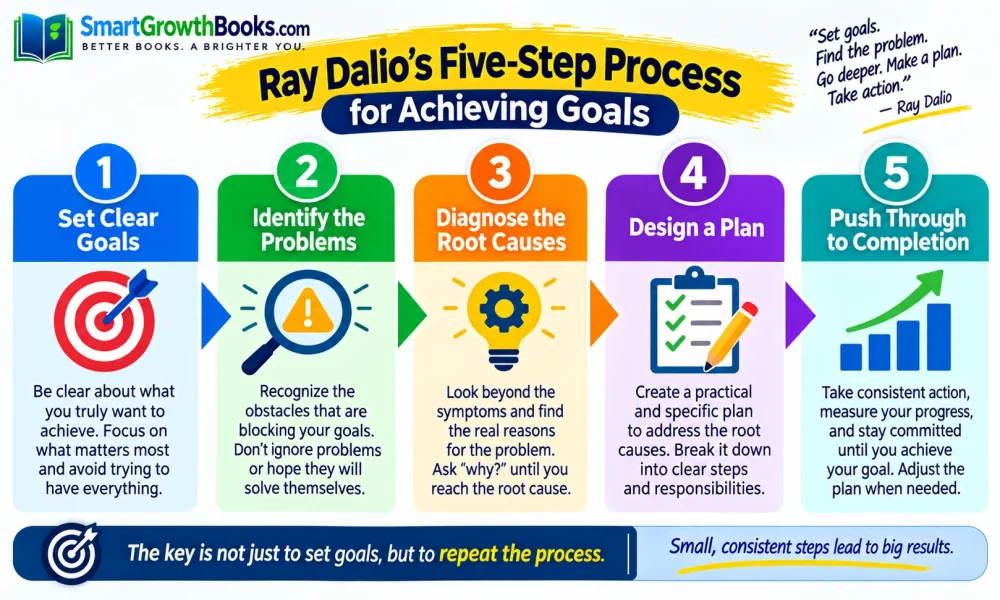
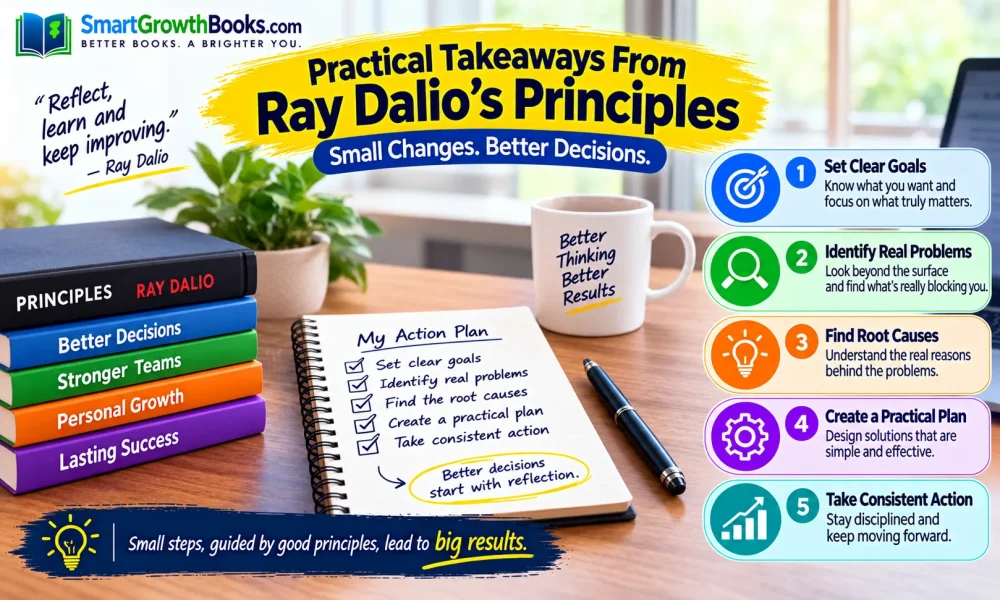
One of the most practical parts of the book is Dalio’s five-step process:
- Set clear goals. Decide what you want to achieve and distinguish your priorities from the things you merely desire.
- Identify the problems blocking you. Recognize obstacles rather than repeatedly working around them.
- Diagnose the root causes. Look beyond symptoms to understand why the problem keeps occurring.
- Design a plan. Decide what actions could address the causes and move you toward your goal.
- Push through to completion. Follow the plan, measure progress, and adjust when the evidence shows that something is not working.
The process is meant to be repeated. Achieving one goal may reveal new challenges, while a failed attempt may show that your diagnosis or plan was incomplete.
Consider someone who wants to publish regularly on a website but repeatedly postpones writing. The first step is to define a realistic publishing goal. Next, identify the obstacle: perhaps research takes too long, the writing process feels overwhelming, or other tasks keep interrupting.
The solution should address the actual cause. Breaking research into smaller sessions, setting a writing schedule, or preparing article outlines in advance may help more than simply demanding greater motivation.
The value of this framework lies in turning a vague ambition into a sequence of decisions and actions.
For a complementary approach to setting and pursuing goals, our Goals by Brian Tracy summary explains another practical framework for turning intentions into action.
Be Radically Open-Minded
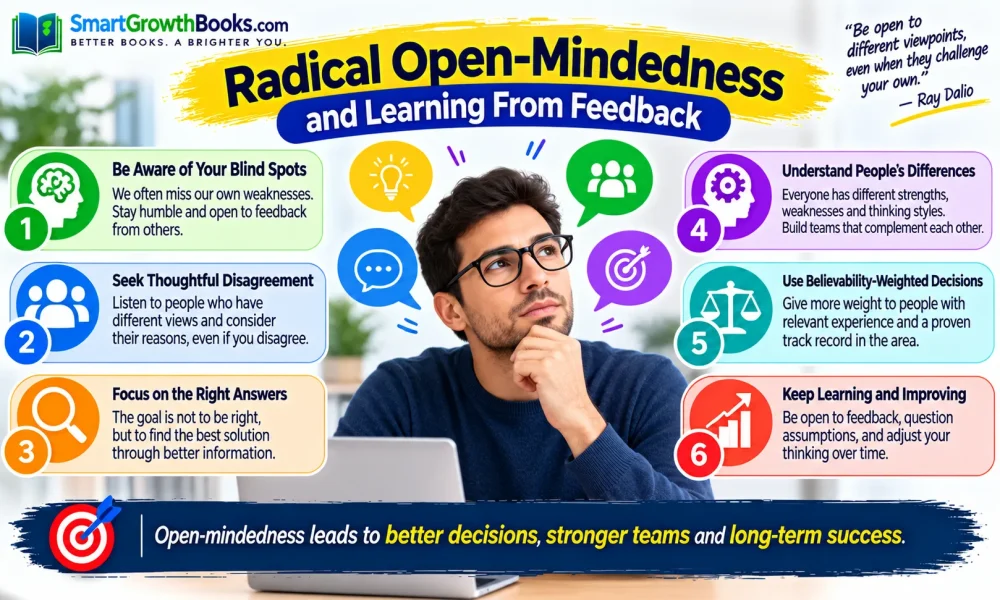
Dalio argues that ego and blind spots can interfere with good judgment. People naturally tend to defend their opinions, especially when criticism feels personal.
Radical open-mindedness means being willing to consider that your current view may be incomplete. It involves listening to people who disagree, examining their reasons, and separating the quality of an argument from how comfortable it makes you feel.
For example, a business owner may believe a product is excellent because customers have praised it. A critical review might reveal a recurring problem that enthusiastic customers never mentioned. Ignoring that feedback protects the owner’s original opinion but sacrifices an opportunity to improve.
Being open-minded does not mean accepting every criticism. It means evaluating feedback on its merits instead of dismissing it automatically.
Understand That People Are Wired Differently
Dalio emphasizes that people have different strengths, weaknesses, preferences, and ways of approaching problems.
Someone who is excellent at developing new ideas may struggle with detailed execution. Another person may be highly organized but less comfortable with uncertainty. Recognizing these differences can help people assign responsibilities more thoughtfully.
This idea is especially useful in teams. Instead of expecting every employee to excel at everything, a manager can identify complementary abilities and distribute work accordingly.
However, personality assessments and labels should not become rigid judgments. People are more complex than a test result, and their abilities can change with experience, training, and circumstances.
The practical lesson is to understand your own tendencies, remain curious about other people, and build working relationships that make good use of different strengths.
Make Decisions Effectively
Dalio treats decision-making as a process that begins with learning and ends with a considered choice.
He recommends examining evidence, identifying assumptions, and recording the criteria behind important decisions. This creates an opportunity to review your reasoning later and determine whether a poor result came from bad luck, incomplete information, or a flawed decision process.
One distinctive concept is believability-weighted decision-making. Rather than giving every opinion equal weight, Dalio suggests considering a person’s relevant experience, track record, and ability to explain their reasoning.
For instance, when evaluating a technical security problem, an experienced security specialist may provide more relevant guidance than someone without that background.
The important qualification is that expertise should be specific to the decision. A person’s success in one field does not automatically make them an authority in another. Evidence, context, and independent judgment still matter.
Readers interested in building better routines around their goals can also explore our comparison of Goals vs Atomic Habits.
Work Principles: Building an Idea Meritocracy
Radical Truth and Radical Transparency
Dalio’s ideal workplace is an idea meritocracy: a culture in which the quality of an idea matters more than the seniority of the person proposing it.
To support this, he advocates radical truth and radical transparency. People should be able to discuss problems openly, challenge assumptions, and share relevant information instead of allowing disagreements to become hidden workplace politics.
Bridgewater became known for practices such as recording meetings and using feedback systems that helped employees assess one another’s strengths and weaknesses.
The intended benefit is better information and faster learning. If a team can identify mistakes early, it has a better chance of correcting them before they become more costly.
But transparency is not automatically healthy. Constant evaluation can make people feel exposed, discourage experimentation, or turn feedback into a source of pressure. Organizations also have legitimate privacy and confidentiality obligations.
The useful takeaway is to encourage honest, respectful disagreement while ensuring that employees can raise concerns without fear of humiliation or retaliation.
Believability in Practice
Dalio’s approach gives greater weight to people with relevant expertise and a demonstrated record of making good decisions in a particular area.
At Bridgewater, tools such as employee “baseball cards” and the Dot Collector were used to record feedback and make differences in people’s strengths more visible.
The purpose was to help teams understand whose judgment might be especially useful for a particular question.
However, a numerical score cannot fully capture a person’s judgment, creativity, ethics, or potential. Feedback systems can also reflect personal bias. They work best when treated as sources of information rather than unquestionable verdicts.
For a smaller team, the principle can be applied without elaborate technology: document important decisions, explain why a recommendation is credible, and invite knowledgeable people to challenge the reasoning.
Mistakes, People, and the Organization as a Machine
Dalio compares an organization to a machine designed to produce results. When the machine repeatedly produces a problem, the manager should investigate the process instead of blaming the latest person involved automatically.
Suppose a company repeatedly sends orders late. The cause may be unclear ownership, poor inventory information, unrealistic delivery estimates, or an inefficient approval process. Telling employees to work harder may not solve any of these problems.
A better response is to identify the cause, assign responsibility for improving the process, and check whether the change works.
Dalio also emphasizes careful hiring, training, evaluation, and matching people to suitable roles. His approach asks managers to consider both the individuals doing the work and the system in which they operate.
The broader lesson is that repeated problems often require better processes, clearer responsibilities, and more effective feedback—not just additional effort.
For another perspective on leadership, innovation, and organizational culture, read our Steve Jobs book summary.

What Principles Does Well, and Where Critics Push Back
The book’s greatest strength is its emphasis on learning from experience. Its five-step process, written decision rules, and encouragement to examine disagreement can be adapted to everyday problems without requiring readers to adopt Bridgewater’s entire culture.
Dalio also discusses his mistakes rather than presenting his career as a sequence of effortless victories. That makes the book more useful than a simple collection of success stories.
Another strength is its specificity. Readers who enjoy frameworks, decision trees, checklists, and systematic reflection will find plenty to consider.
Still, the book has real limitations.
First, it is long and sometimes repetitive. Readers looking for a concise introduction to personal growth may find the detailed rules overwhelming.
Second, many recommendations come from Dalio’s experience and the environment of a major investment firm. A practice that works in one organization does not necessarily suit a small business, a school, a creative team, or a family.
Third, the emphasis on radical transparency and direct feedback can be uncomfortable or counterproductive if implemented without respect, context, and psychological safety. Critics of Bridgewater have questioned the human cost of its demanding workplace culture. Dalio’s supporters and the firm have disputed aspects of critical accounts, so the controversy should not be reduced to a simple verdict.
Finally, the book is a founder’s framework, not a guarantee of results. Readers should test its recommendations against evidence, their own values, and the needs of the people affected by their decisions.
Who Should Read Principles, and Who Should Skip It
Who Should Read It
- Founders, managers, and team leaders: The work principles offer ideas about feedback, hiring, accountability, and decision-making.
- Systems thinkers: Readers who enjoy converting recurring problems into written rules and repeatable processes may appreciate Dalio’s approach.
- Goal-driven readers: The five-step process provides a structured way to diagnose obstacles and improve plans.
- Readers interested in business culture: The book offers an inside view of one influential firm’s approach to organizational design, alongside questions about its limitations.
Who Might Prefer Another Book
- Readers wanting a short, light read: The original book is detailed and list-heavy. A shorter introduction may be a better starting point.
- People who cannot change their workplace: Some work principles assume that readers have authority to influence hiring, feedback, and organizational culture.
- Readers seeking investment instructions: Despite Dalio’s background, Principles: Life and Work primarily discusses decision-making, personal development, and management rather than offering a practical guide to stock selection or market timing.
- Readers who prefer research-led management books: Dalio’s personal experience is valuable, but it should not be confused with independent proof that every recommendation will work in every setting.
If you are unsure, read the life principles first and choose the work principles most relevant to your situation.
Final Thoughts on This Ray Dalio Principles Summary
The central lesson of this principles ray dalio summary is not that every reader should follow Dalio’s rules. It is that experience becomes more useful when you reflect on it, record what you learn, and apply those lessons deliberately.
Principles: Life and Work offers a framework for facing reality, diagnosing problems, making decisions, and improving organizations. Its greatest ideas can be useful, but its most demanding workplace practices should be adapted carefully rather than copied automatically.
A thoughtful principles life and work summary should leave readers with questions as well as answers: Which recurring problems do you face? What evidence supports your current approach? What could you change, and how will you know whether the change helped?
Start with one real problem this week. Identify its likely cause, design a practical response, and review the result. Keep what works, revise what does not, and develop your own principles over time.
Don’t just read better ideas. Put the useful ones to work.
About the Author
Muhammad Ajmal
Founder & Book Summary Writer at SmartGrowthBooks
Muhammad Ajmal researches and writes practical book summaries focused on self-help, productivity, psychology, personal finance, motivation, and personal growth.
This Summary is published on October 2026.
Related Book Summaries
Stay Smarter Every Week
Get practical book summaries, productivity tips, and self-improvement insights delivered to your inbox.