
Table of Contents
ToggleNever Finished vs Can’t Hurt Me in 2026: Which Goggins Book Should You Read First?
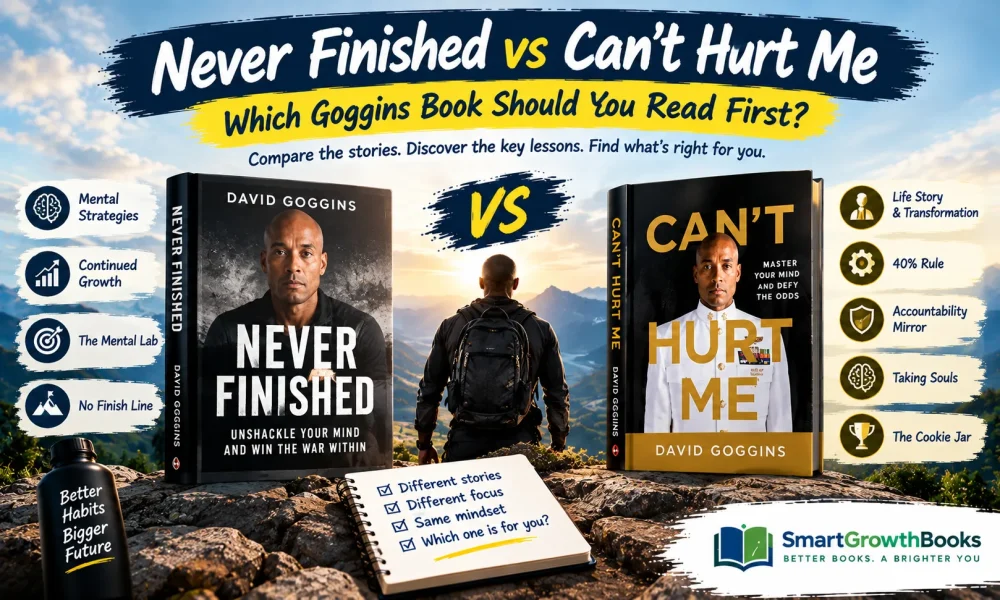
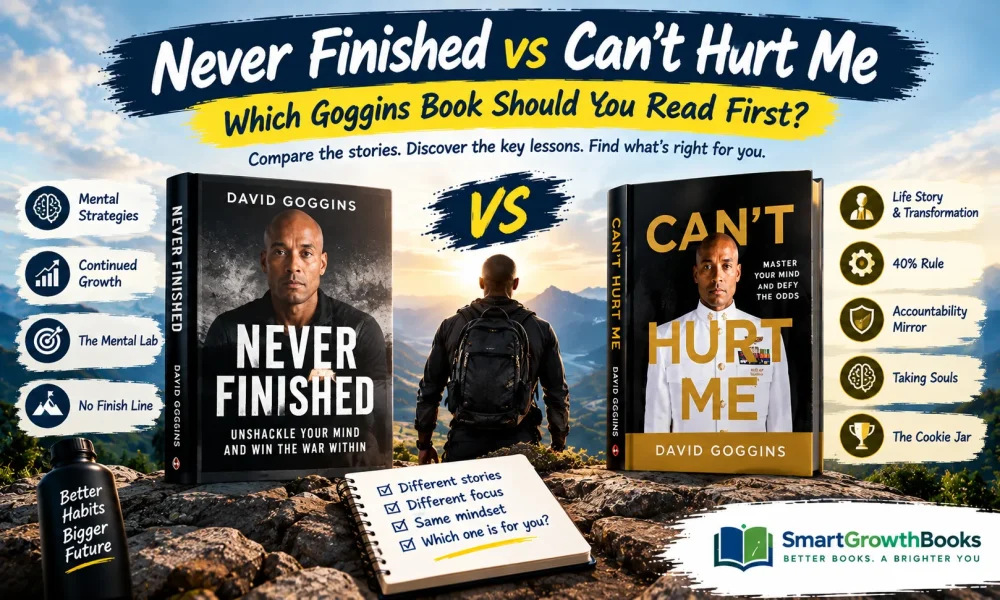
If you’re searching for never finished vs can’t hurt me, you’re probably trying to answer a simple question: which David Goggins book should you read first? Both books explore discipline, discomfort, self-accountability and the process of pushing beyond perceived limitations. But they approach those ideas from different points in Goggins’ life.
Can’t Hurt Me, first published in 2018, is built around Goggins’ life story and the experiences that shaped his philosophy. Never Finished, published as the follow-up in 2022, takes readers further into the ideas and strategies he developed after those earlier experiences.
This Never Finished vs Can’t Hurt Me comparison explains the main differences, what each book does well, where each one falls short, and which type of reader may get more from each.
Never Finished vs Can’t Hurt Me: The Short Answer
If you’re completely new to David Goggins, Can’t Hurt Me provides the stronger starting point because it establishes his background and introduces many of the ideas that made him well known.
If you’ve already read Can’t Hurt Me and want to explore how Goggins’ thinking developed further, Never Finished provides that next step.
That doesn’t mean one book is universally better. The more useful question is:
What are you looking for right now—Goggins’ story and foundational ideas, or a deeper look at continued growth and mental evolution?
What Is Can’t Hurt Me About?
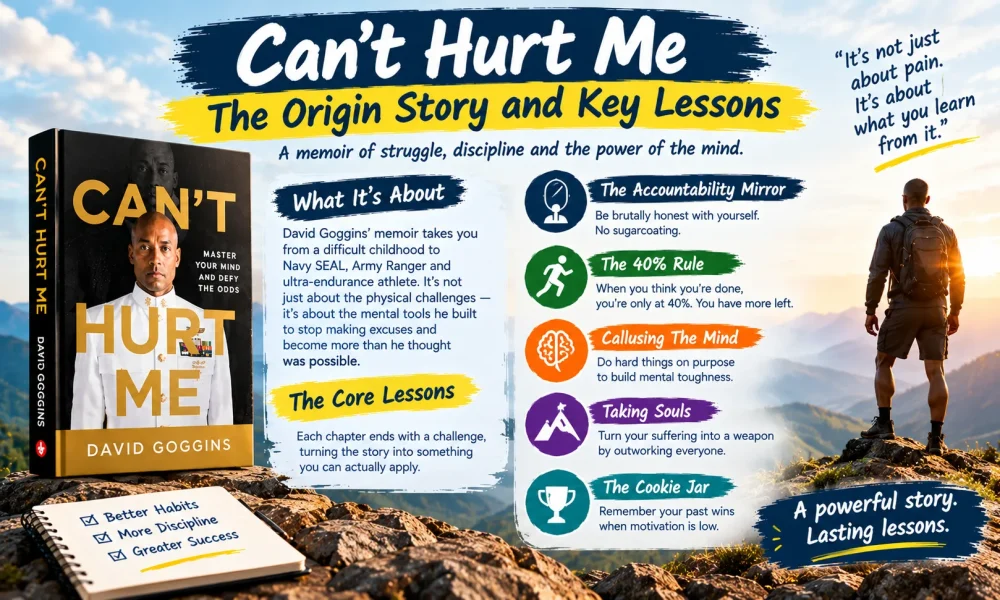
Can’t Hurt Me: Master Your Mind and Defy the Odds combines memoir and personal-development ideas. Goggins describes a childhood marked by poverty, prejudice and physical abuse, followed by struggles with weight and his eventual transformation through military training and endurance challenges.
The book’s famous ideas include the 40% Rule, the Accountability Mirror, callusing the mind, Taking Souls, and the Cookie Jar.
The official Goggins material describes the 40% Rule as the idea that people may have more capacity available when their mind tells them they have reached their limit. The book is also structured around challenges connected to its lessons, which gives it a practical element rather than making it only a memoir.
What Can’t Hurt Me Does Well
Its biggest strength is the connection between story and lesson. Instead of simply telling readers to become more disciplined, Goggins shows how his ideas developed through difficult experiences. That makes the book particularly accessible to someone who has never encountered his philosophy before.
If you’re interested in Goggins’ approach to discipline, you can also read our Can’t Hurt Me summary.
Where Can’t Hurt Me Falls Short
The intensity can also be its weakness. Goggins’ experiences are unusual, and some readers may find it difficult to translate extreme military and endurance examples into ordinary life. The original book also uses strong language, although a curse-word-free edition is available.
What Is Never Finished About?
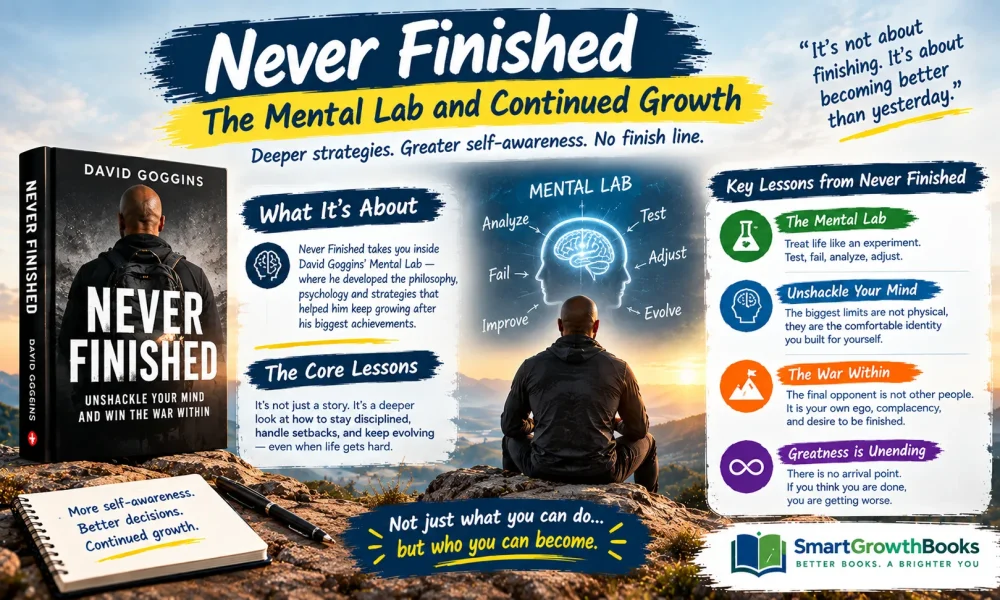
Never Finished: Unshackle Your Mind and Win the War Within is the follow-up to Can’t Hurt Me. The official description says that Goggins takes readers inside his Mental Lab, where he developed the philosophy, psychology and strategies that shaped his later approach to growth.
Its structure is different from a straightforward chronological memoir. The contents include nine main chapters, with eight of those chapters followed by an Evolution section. The book explores ideas such as belief, discipline, self-examination, failure, continued evolution and the danger of becoming comfortable after achieving something.
What Never Finished Does Well
The book is particularly relevant to the idea that progress doesn’t automatically end when you reach a goal. Its Mental Lab concept encourages readers to examine themselves, identify weaknesses and continue experimenting with ways to improve.
If your focus is goal setting and long-term direction, our Goals by Brian Tracy summary provides another perspective.
Where Never Finished Falls Short
The same intensity that attracts Goggins’ audience remains present. Some readers may also find the book repetitive or less straightforward than Can’t Hurt Me. And because much of the philosophy comes from Goggins’ personal experiences, readers should distinguish between his personal approach to discipline and universally supported psychological or medical advice.
Never Finished vs Can’t Hurt Me: 5 Key Differences
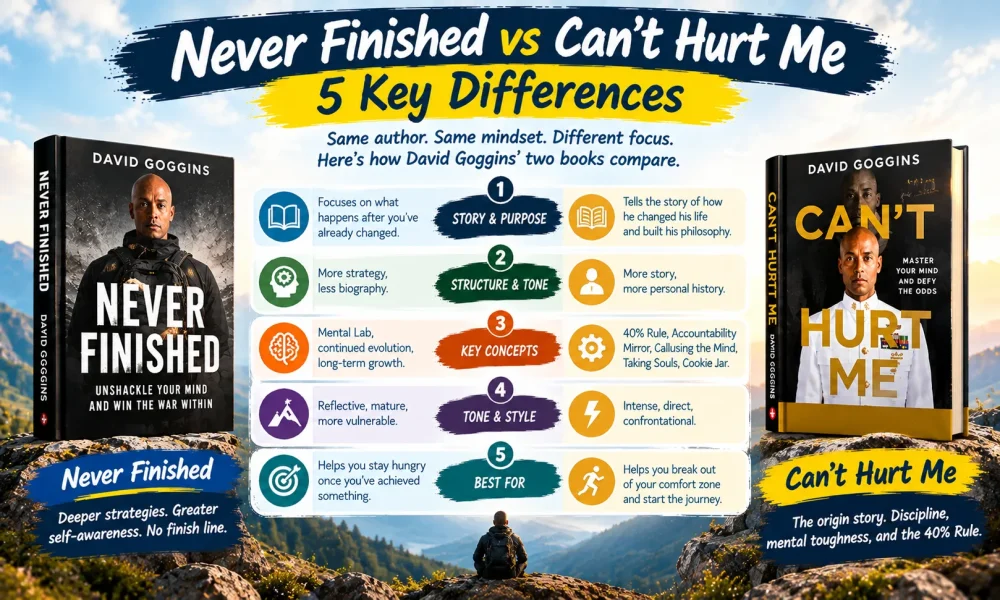
1. Memoir Foundation vs Continued Evolution
Can’t Hurt Me spends more time establishing who David Goggins is and how he became that person.
Never Finished assumes more familiarity with his story and concentrates more heavily on his continuing philosophy.
This makes the first book easier to approach as an introduction.
2. Starting from the Bottom vs Avoiding the Plateau
A major theme of Can’t Hurt Me is transformation. The book follows Goggins as he confronts circumstances, habits and beliefs that he wanted to change. Readers interested in building consistency rather than relying on intensity may also want to explore our Atomic Habits summary.
Never Finished focuses more on what happens after previous achievements have already been made. Its central idea is that reaching one level doesn’t mean you’ve reached the end. The official description itself frames Never Finished around the idea that what Goggins once thought was his limit was only his beginning.
3. Named Tools vs Deeper Mental Frameworks
Can’t Hurt Me is particularly memorable for named concepts such as:
- The Accountability Mirror
- The 40% Rule
- Callusing the Mind
- The Cookie Jar
- Taking Souls
These ideas give beginners clear concepts to remember. Never Finished expands into concepts such as the Mental Lab and continued personal evolution. So the books overlap, but their emphasis is different.
4. Life Story vs Reflection
Can’t Hurt Me derives much of its impact from the contrast between Goggins’ early circumstances and his later achievements.
Never Finished spends more time examining what happens after transformation has already begun.
This can make the second book feel more reflective for readers who already know the first.
5. Beginner Motivation vs Long-Term Development
Someone trying to make a major change may connect strongly with the directness of Can’t Hurt Me.
Someone who has already developed routines but feels stuck may find the continuing-evolution theme of Never Finished more relevant.
Neither situation makes one book universally superior. It depends on what problem you’re trying to solve.
What Do Reader Ratings Tell Us?
Goodreads currently shows Can’t Hurt Me at about 4.30 from more than 334,000 ratings, while Never Finished is around 4.38 from more than 50,000 ratings. Those figures show strong reader interest in both books, but they should not be treated as a scientific comparison.
The audiences are also different: Never Finished is a follow-up, so many people reading it already know Goggins and may be particularly interested in his style. For that reason, star ratings are useful context, but they don’t answer the question of which book is right for you.
What’s New About Goggins in 2026?
There is an interesting real-world development in 2026.
Military Times reported in March 2026 that Goggins, then 51, had reenlisted in the Air Force and been assigned to the Special Warfare Training Wing. The Air Force confirmed his assignment but said it could not discuss his training status or progression.
The story is particularly interesting in the context of Never Finished because the book discusses Goggins’ earlier experience with Air Force pararescue training and the way failure influenced his later development. The 2026 report says his earlier pararescue attempt ended after he accepted a medical option to leave training.
This doesn’t prove that the book’s philosophy works. But it does provide a notable 2026 context for readers revisiting his story.
Who Should Read Can’t Hurt Me First?
Can’t Hurt Me may be a good starting point if:
- You’ve never read a David Goggins book.
- You want to understand his background.
- You enjoy memoirs mixed with personal-development ideas.
- You’re interested in discipline and self-accountability.
- You prefer practical concepts introduced through stories.
It’s also the better entry point if you want to understand the background behind ideas that Goggins develops further in Never Finished.
Who Should Read Never Finished First?
You can read Never Finished without reading the first book, but much of its context will be clearer if you already know Goggins earlier story. It may appeal particularly to readers who:
- Have already read Can’t Hurt Me.
- Want more of Goggin’s philosophy.
- Are interested in continued personal development.
- Want to examine discipline after achieving an initial goal.
- Prefer reflection and mental frameworks over a conventional autobiography.
Who Might Not Enjoy Either Book?
Neither book will appeal to everyone. You may want to look elsewhere if you:
- Prefer research-heavy psychology.
- Dislike aggressive or confrontational motivational writing.
- Prefer gentle habit-building approaches.
- Don’t enjoy memoirs about extreme physical challenges.
- Want a conventional step-by-step self-help program.
The books are best understood as Goggins’ personal philosophy and experiences, rather than universal instructions for how every person should live.
A Necessary Caution About Goggins’ Approach
One of the most important things to understand when comparing never finished vs cant hurt me is the difference between learning from someone’s mindset and copying their lifestyle.
Goggins’ experiences include extreme military training, endurance events and significant physical challenges. His approach is built around deliberately confronting discomfort, but that does not mean every reader should reproduce his physical methods. Even Goggins has acknowledged that his lifestyle is not for everyone.
A useful takeaway is to separate the principle from the specific example. You can learn from self-accountability without copying an extreme training routine. You can learn from persistence without ignoring injury. You can challenge yourself without assuming that more suffering automatically produces better results. That distinction makes both books more useful for an ordinary reader.
Never Finished vs Can’t Hurt Me: Which Should You Read First?
If you’re completely new to David Goggins, start with Can’t Hurt Me. It establishes his story, introduces his major concepts and gives you the background needed to understand his later thinking. Then, if you find his philosophy useful and want to explore it further, read Never Finished. If you’ve already read Can’t Hurt Me, Never Finished is the natural next book.
So rather than asking only “can’t hurt me vs never finished—which is better?” ask: “Which book fits what I need right now?”
For a first introduction: Can’t Hurt Me.
For a follow-up focused on continued evolution: Never Finished.
For readers interested in Goggins as a whole, reading both in publication order provides the clearest progression.
Final Takeaway
The biggest difference between these two books isn’t simply that one came first. It’s the stage of personal development they emphasize. Can’t Hurt Me introduces the story and foundational ideas behind Goggins’ philosophy.
Never Finished builds on that foundation and explores the idea that growth continues even after you’ve already achieved something significant. Goggins’ own site describes the second book as an extension of the first, taking readers deeper into the Mental Lab and the strategies behind his later philosophy.
You don’t have to agree with every part of Goggins’ approach to take something useful from either book. Read the stories. Question the methods. Keep the principles that genuinely help you.
Our Take
For SmartGrowthBooks, I’d frame the comparison this way:
Can’t Hurt Me is the better introduction to David Goggins. Never Finished is the more natural follow-up for readers who want to explore his philosophy further.
That is more useful than simply declaring one book the universal “winner.” The value of both books ultimately depends on the reader’s goals, personality and circumstances.
Ready to Explore More Personal Growth Books?
You don’t need to adopt an extreme lifestyle to learn something from an extreme story. Start with one useful idea from the books you’ve read, apply it to your own life, and see what actually works for you.
If you enjoy practical ideas from books about mindset, discipline, productivity, personal growth and self-improvement, keep exploring SmartGrowthBooks for thoughtful summaries, comparisons and lessons you can apply to everyday life.
Don’t just read better ideas. Put the useful ones to work.
About the Author
Muhammad Ajmal
Founder & Book Summary Writer at SmartGrowthBooks
Muhammad Ajmal researches and writes practical book summaries focused on self-help, productivity, psychology, personal finance, motivation, and personal growth.
This Summary is published on September 2026.
Related Book Summaries
Stay Smarter Every Week
Get practical book summaries, productivity tips, and self-improvement insights delivered to your inbox.