
Can't Hurt Me Summary & Review in 2026: Chapter, Lessons + Reddit
Can’t Hurt Me review and summary in 2026: chapter-by-chapter overview, key lessons, Reddit reactions, strengths, criticisms, and whether it’s worth reading.
Book: Can’t Hurt Me
Author: David Goggins
Published: 2018
Pages: 364
Genre: Memoir
Reading Time: 10 Minutes
Table of Contents
ToggleIntroduction
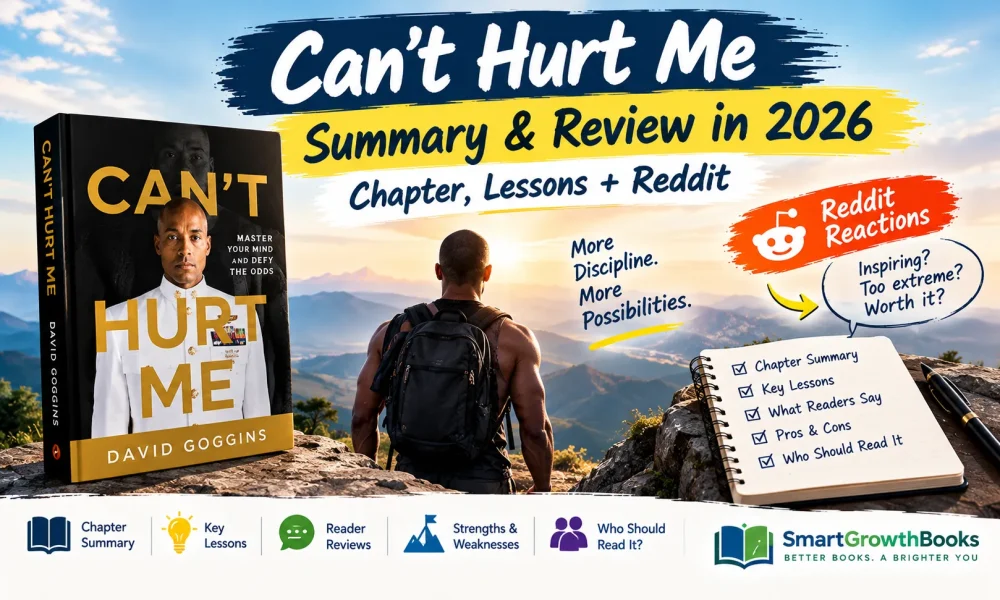
If you’re looking for a can’t hurt me review that goes beyond motivational quotes, David Goggins’ Can’t Hurt Me: Master Your Mind and Defy the Odds is worth examining from both sides.
Published in 2018, the book combines memoir and personal-development lessons. Goggins describes his difficult childhood, his transformation from an overweight young man into a Navy SEAL and endurance athlete, and the mental strategies he developed along the way. The book’s central ideas include the 40% Rule, Accountability Mirror, Cookie Jar, callusing the mind, and learning from failure.
But there is an important distinction: Can’t Hurt Me is Goggins’ story and philosophy, not a universal training manual. Some of its ideas can be adapted to everyday life, while his extreme physical challenges should not automatically be treated as instructions to imitate.
If you’re interested in other books about personal growth and behavior change, you can also explore our Atomic Habits summary.
Can’t Hurt Me Synopsis: What Is the Book About?
The simplest can’t hurt me synopsis is this:
Can’t Hurt Me is the story of how David Goggins confronted a painful childhood, low self-confidence, physical limitations, and repeated setbacks and used discipline, discomfort, and self-accountability to change his life.
Goggins describes growing up with poverty, prejudice, abuse, learning difficulties, and fear. Later, he became overweight and unhappy before deciding to pursue a radically different path. His journey eventually included military training, Navy SEAL service, endurance races, and record-setting physical challenges.
The book is therefore more than a collection of motivational advice. The lessons are connected to events in Goggins’ own life. That is also what makes the book powerful—and controversial. His experiences show what one person was willing to endure, but readers should separate the underlying mental principles from the extreme methods he sometimes used to test himself.
Can’t Hurt Me Chapter Summary: The 11 Chapters Explained
The book contains an introduction followed by eleven chapters. The following cant hurt me chapter summary focuses on the central idea of each chapter rather than reproducing the book.
Introduction: The 40% Rule
Goggins introduces the idea that people often stop because their minds interpret discomfort as a signal that they have reached their limits. The 40% Rule becomes a metaphor for questioning that first urge to quit.
The useful takeaway is not that everyone literally has another 60% available. Rather, Goggins encourages readers to examine whether their perceived limit is actually a limit.
Chapter 1: I Should Have Been a Statistic
Goggins describes his childhood, including abuse, poverty, prejudice, school difficulties, and the psychological effects of his early experiences. The chapter establishes an important theme of the book: your past can influence your identity, but you can still take responsibility for what you do next.
Chapter 2: Truth Hurts
This chapter introduces the Accountability Mirror. Instead of avoiding weaknesses and excuses, Goggins confronts them directly. He writes down the problems he needs to address and uses that list as a daily reminder. The broader lesson is that honest self-assessment comes before meaningful change.
Chapter 3: The Impossible Task
Goggins decides to pursue Navy SEAL training and faces the enormous challenge of transforming his physical condition. The chapter emphasizes repetition, discipline, preparation, and continuing after setbacks.
Chapter 4: Taking Souls
Goggins describes BUD/S and Hell Week and introduces the idea of “taking souls.” In his framework, this means responding to people who expect you to fail by performing under pressure rather than arguing with them. The useful version of this lesson is not revenge. It is learning to remain focused when other people’s expectations become distracting.
Chapter 5: Armored Mind
Goggins develops what he calls a calloused mind—a mind trained to tolerate discomfort. He describes preparing for difficult situations by mentally confronting what could go wrong instead of assuming everything will be easy.
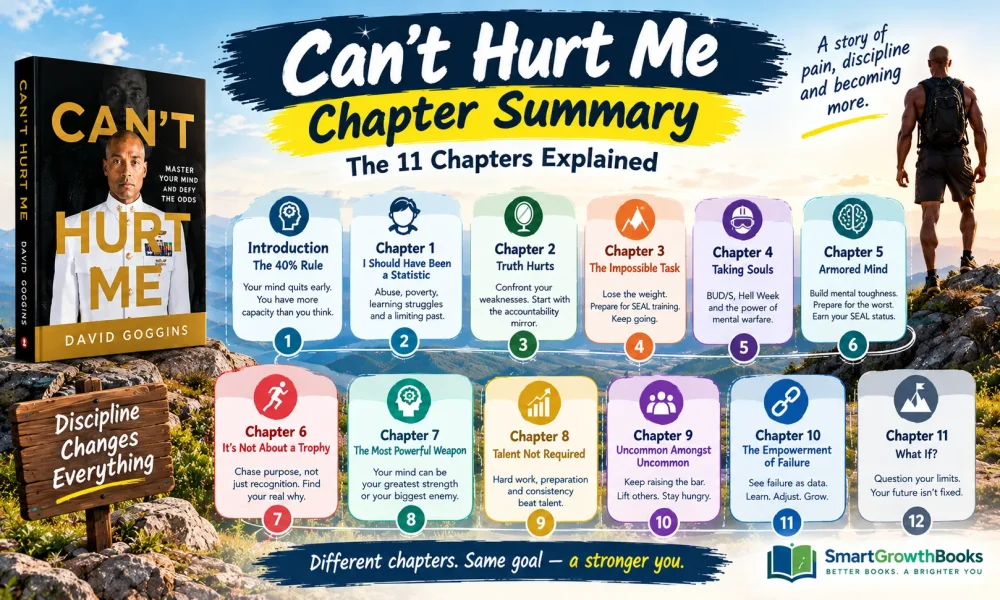
Chapter 6: It’s Not About a Trophy
This chapter moves beyond achievement. Goggins begins questioning whether medals, records, and external recognition can solve deeper personal problems. The lesson is important because achieving a goal does not automatically resolve every internal struggle.
Goggins’ emphasis on deliberate action can also be compared with Brian Tracy’s structured approach in our Goals by Brian Tracy summary.
Chapter 7: The Most Powerful Weapon
Goggins continues exploring the mind as a source of both limitation and strength. The Cookie Jar becomes an important tool: remembering previous achievements and difficult experiences can provide evidence that you have overcome challenges before.
Chapter 8: Talent Not Required
Goggins turns toward endurance and athletic challenges. The central message is that talent alone does not determine performance. Consistent effort, preparation, persistence, and willingness to improve can matter enormously.
Chapter 9: Uncommon Amongst Uncommon
Goggins discusses what happens after achieving something difficult. Instead of becoming satisfied immediately, he pushes himself toward new standards. The useful lesson is to continue learning rather than treating one achievement as the end of development.
Chapter 10: The Empowerment of Failure
Failure becomes information. Rather than treating failure only as proof of inadequacy, Goggins looks at what went wrong and what can be changed. This is one of the more practical ideas in the book because it turns setbacks into opportunities for review.
Chapter 11: What If?
The final chapter brings the book back to the question of potential. Goggins asks readers to consider what might become possible if they stopped automatically accepting the limitations they had placed on themselves. The question is less about becoming another David Goggins and more about examining your own assumptions about what you can improve.
Can’t Hurt Me Lessons Worth Keeping
Here are the can’t hurt me lessons that translate most easily into everyday life.
1. Practice Radical Self-Accountability
The Accountability Mirror is essentially a method for identifying weaknesses instead of hiding from them. Write down what is not working, decide what you can control, and identify the next action.
2. Question Your First Urge to Quit
The 40% Rule can be useful as a reminder that discomfort does not always mean failure. Before abandoning a difficult task, ask:
Am I actually unable to continue, or am I simply uncomfortable?
That distinction can change how you respond to challenges.
3. Keep a Mental Cookie Jar
Remembering previous successes can provide useful evidence when confidence drops. You can create your own version by keeping a list of difficult things you have already completed.
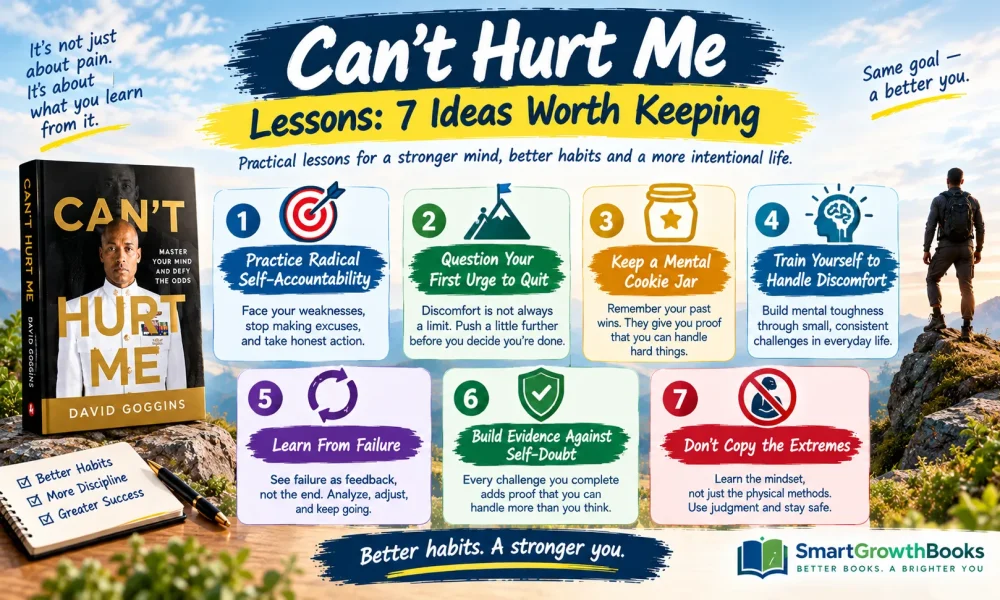
4. Train Yourself to Handle Discomfort
Mental toughness develops through practice. That does not require extreme physical suffering. A difficult conversation, an early start, focused work without distractions, or finishing an important task can all provide manageable opportunities to practice discomfort.
5. Learn From Failure
Instead of asking only, “Why did I fail?”, ask:
- What went wrong?
- What was under my control?
- What did I learn?
- What will I change next time?
This turns failure into feedback.
6. Build Evidence Against Self-Doubt
One of the strongest themes in the book is that confidence can come from evidence. Every time you keep a commitment, finish a difficult task, or recover from a setback, you create another piece of evidence that you can handle challenges.
7. Don’t Copy the Extremes
This may be the most important modern interpretation of Can’t Hurt Me. Goggins’ story contains extraordinary physical challenges and injuries. Readers can learn from his discipline without assuming that pain, exhaustion, or injury automatically represents progress. The mindset can be adapted. The extreme circumstances do not need to be copied.
Can’t Hurt Me Review: What Does the Book Get Right?
One of the book’s greatest strengths is its storytelling. Goggins does not present his lessons as abstract theories. He connects them to specific events in his life, which makes the ideas easier to remember. The challenges at the end of chapters also make the book more practical than a memoir that simply tells a story.
Another strength is its directness. Readers who dislike vague motivational advice may appreciate the book’s emphasis on responsibility, action, and discomfort. There is also substantial evidence of continuing reader interest. Goodreads currently lists the book at about 4.3/5 from more than 330,000 ratings, although reader ratings are not the same thing as independent evidence that every claim in the book is effective.
Where Can’t Hurt Me Falls Short
The biggest limitation is that Goggins’ personal experience can be easy to overgeneralize. What worked for one exceptionally driven endurance athlete does not automatically become a safe or effective method for everyone.
The book also places heavy emphasis on suffering, discipline, and pushing through resistance. Readers can interpret those ideas too literally. Another limitation is repetition. Some readers find the relentless motivational tone powerful, while others find it excessive.
Finally, the book is primarily a memoir and motivational framework—not a comprehensive psychology textbook, medical guide, or scientifically validated training program. That distinction matters when applying its lessons.
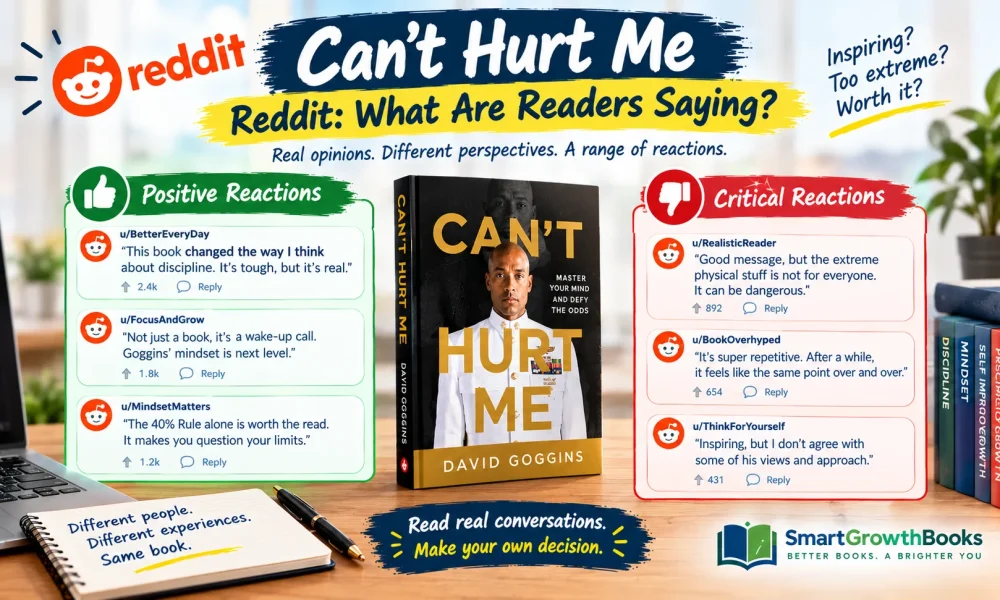
Can’t Hurt Me Reddit: What Are Readers Saying?
If you searched for can’t hurt me reddit, you will find both enthusiastic praise and strong criticism.
Recent Reddit discussions show readers praising the book for challenging excuses, improving discipline, and changing how they think about discomfort. At the same time, other readers warn that Goggins’ physical behavior should not be copied literally and that pushing through pain without appropriate judgment can lead to injury.
That split is important. The Reddit discussion is not a scientific consensus, and Reddit opinions vary by community and individual experience. But the recurring debate is useful:
Should readers copy Goggins’ methods, or learn from the mindset behind them?
A reasonable way to approach the book is to separate those two things. Take the lessons about accountability, persistence, preparation, and learning from failure. Use judgment when it comes to extreme physical challenges.
Who Should Read Can’t Hurt Me?
This book may appeal to readers who:
- Feel stuck in procrastination or comfort.
- Enjoy intense personal-development stories.
- Want a strong motivational push.
- Are interested in military or endurance stories.
- Want practical exercises alongside a memoir.
- Need to examine their excuses and commitments.
It may be particularly interesting for readers who respond well to direct, challenging writing.
Who Should Skip or Approach It Carefully?
The book may not be the right choice if you are looking for a calm, research-focused introduction to psychology or habit formation. It also contains descriptions of childhood abuse, racism, physical hardship, injury, and intense training. Readers who find those subjects difficult should know what to expect.
Most importantly, the book should not be treated as a medical or athletic training plan. If you are injured, exhausted, dealing with significant mental-health difficulties, or struggling with trauma, “pushing harder” is not automatically the appropriate solution.
Can’t Hurt Me vs. Never Finished
David Goggins later published Never Finished in 2022. For readers deciding between the two, Can’t Hurt Me is the natural starting point because it establishes the story and the core ideas that made Goggins widely known. Never Finished continues the exploration of his mindset and later experiences. If you want to understand where the philosophy began, start with Can’t Hurt Me.
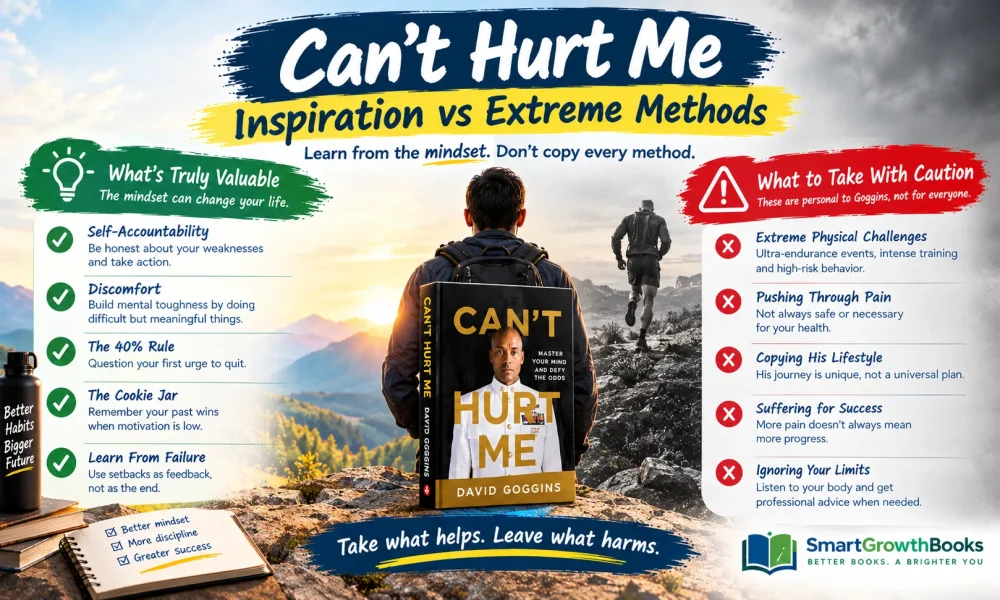
Final Takeaway: Is Can’t Hurt Me Still Worth Reading in 2026?
Can’t Hurt Me remains an unusually intense combination of memoir and personal-development writing. Its strongest lessons are not necessarily about running farther, suffering more, or copying Goggins’ physical achievements. They are about honesty, accountability, persistence, deliberate discomfort, learning from failure, and questioning the limits you automatically accept.
The best way to read the book in 2026 is critically. Take the ideas that help you become more disciplined and responsible. Question the parts that encourage unnecessary suffering. Treat Goggins’ experiences as his experiences rather than universal instructions. That makes Can’t Hurt Me more useful—and more realistic—as a personal-growth book.
Our Take
At SmartGrowthBooks, we think the most valuable way to approach Can’t Hurt Me is to separate inspiration from imitation. You do not need to become David Goggins to benefit from David Goggins’ story.
You can use the Accountability Mirror to become more honest with yourself, the Cookie Jar to remember previous wins, and the idea of voluntary discomfort to practice doing difficult but meaningful things.
The goal isn’t to suffer more. The goal is to become more intentional about what you are capable of improving.
Ready to Turn the Lessons into Action?
You don’t need to transform your life overnight. Choose one area where you have been making excuses, write down what needs to change, and take one uncomfortable but reasonable action this week.
If you enjoy practical ideas from books about mindset, personal growth, productivity, discipline, and self-improvement, keep exploring SmartGrowthBooks for thoughtful summaries, reviews, and lessons you can actually apply.
Don’t just read better ideas. Put the useful ones to work.
About the Author
Muhammad Ajmal
Founder & Book Summary Writer at SmartGrowthBooks
Muhammad Ajmal researches and writes practical book summaries focused on self-help, productivity, psychology, personal finance, motivation, and personal growth.
This Summary is published on September 2026.
Related Book Summaries
Stay Smarter Every Week
Get practical book summaries, productivity tips, and self-improvement insights delivered to your inbox.